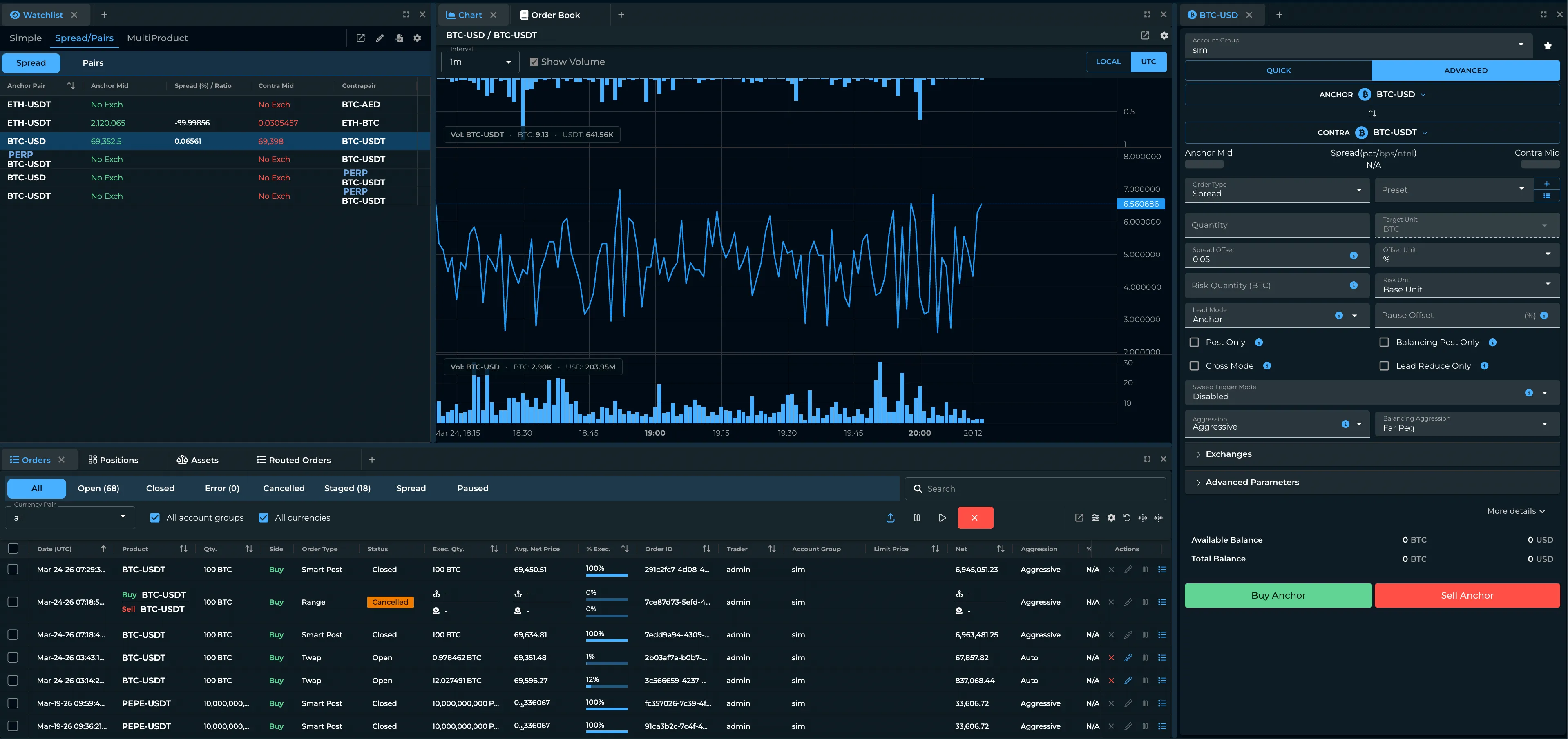
A TWAP includes an end-of-interval catch-up: if it falls behind, it fires an immediate-or-cancel (IOC) order to stay on schedule — which, in thin markets, forces aggressive fills at unfavorable prices. Scheduled Post spreads execution across the same intervals but passively, is allowed to get ahead of schedule, and never forces a catch-up. For illiquid names and patient, cost-sensitive orders, that one difference is the whole point.
Where TWAP's catch-up hurts
TWAP keeps an order on pace by checking, at the end of each interval, whether it has traded its target quantity. If it hasn't, it sends an IOC order to take whatever liquidity it needs to catch up. In a deep, liquid market that is usually harmless. In a thin one, it is the opposite:
- Passive fills lag because there simply isn't much resting volume on the other side.
- The interval ends, the algorithm is behind, and it sweeps the book to catch up.
- That sweep crosses the spread and walks up (or down) several price levels — exactly the slippage the order was trying to avoid.
This is a well-known failure mode for TWAP on illiquid tokens: the schedule is honored, but the catch-up mechanism manufactures market impact at the worst possible moments.
What Scheduled Post does instead
Scheduled Post targets the same kind of even, time-distributed execution, but with two key behavioral differences:
- It posts passively. Each slice rests in the book to earn maker fills rather than taking liquidity.
- There is no forced catch-up. It is allowed to get ahead of schedule when liquidity is good, and it will not force fills when liquidity is poor. If it falls behind, it stays behind rather than sweeping.
The trade-off is explicit and deliberate: you give up the guarantee of finishing exactly on a schedule in exchange for never being penalized by an IOC catch-up. For passive, patient flow — especially in illiquid names — that is usually the right trade.
TWAP vs. Scheduled Post
| Dimension | TWAP | Scheduled Post |
|---|---|---|
| Posture | Mixed; takes liquidity to stay on pace | Passive (posts for maker fills) |
| Behind schedule | IOC catch-up sweep | Stays behind; no forced fills |
| Ahead of schedule | Held to the schedule | Allowed to run ahead |
| Best market | Liquid | Illiquid / thin |
| Main risk | Catch-up slippage | May not complete on time |
| Fee profile | Taker on catch-up | Maker-first |
Choosing between them
A simple way to decide:
- Is finishing on time the priority? Use TWAP — its catch-up exists precisely to honor the deadline.
- Is avoiding slippage the priority, and can you tolerate variable completion? Use Scheduled Post — its passive, no-catch-up behavior protects price on thin names.
- Is the order governed by a limit price rather than a schedule? Consider TimePace, which paces without a hard end-time.
- Do you want to pace against traded volume rather than the clock? Consider POV.
For illiquid spot tokens specifically, passive behavior and getting ahead of schedule when the chance appears is usually acceptable — which is why Scheduled Post is the common recommendation over TWAP in those cases. All of these run on CoinRoutes' consolidated order book and smart order routing, so each slice still seeks the best net price across venues.
Markets are dynamic and the right settings depend on real-time conditions. Algorithms support execution but do not guarantee outcomes. This article describes what the algorithm does and when to use it, not its proprietary internals.
Frequently asked questions
How is Scheduled Post different from TWAP? Both spread an order across time intervals, but TWAP forces an IOC catch-up to stay on schedule, while Scheduled Post executes passively, is allowed to get ahead of schedule, and never forces a catch-up.
Why does TWAP cause slippage on illiquid names? When passive fills lag in a thin market, TWAP's end-of-interval catch-up sweeps the book to stay on pace, crossing the spread and walking through price levels — generating the very impact the order tried to avoid.
What's the downside of Scheduled Post? Because it never forces fills, it may not complete by a particular time. You trade schedule certainty for protection against catch-up slippage.
Which should I use for a thin token? Scheduled Post is generally preferred for illiquid names, where passive execution and getting ahead of schedule when liquidity appears is acceptable, and a forced catch-up would be costly.
Trading a thin name and worried about catch-up slippage? Book a demo to see Scheduled Post in action.
Related reading: Why CoinRoutes' TWAP Outperforms a Basic TWAP · TimePace vs TWAP · POV vs TWAP · What Is Slippage? · What Is Liquidity Aggregation?