What Is Algorithmic Trading for Crypto, and How Does It Differ from Equities/FX Algos?
CoinRoutes
Algorithmic trading is the use of automated, rules-based systems to execute orders — deciding when, where, how fast, and in what size to trade without manual intervention on every slice. The concepts come from equities and FX, but crypto's market structure changes how these algorithms must be built and behave. This guide explains crypto algo trading and the specific ways it differs from its traditional cousins.
What algorithmic trading means here
In an execution context, "algorithmic trading" usually refers to execution algorithms — strategies like TWAP, VWAP, POV, and Implementation Shortfall that work a large order intelligently to reduce slippage and market impact. (This is distinct from fully automated trading strategies that decide what to buy or sell; here the focus is on executing a decision well.) The trader sets the objective and constraints; the algorithm handles the mechanics of releasing child orders into the market.
The shared foundation with equities and FX
The core toolkit is common across asset classes:
Slice large orders into smaller child orders.
Pace execution by time (TWAP), volume (VWAP/POV), or arrival-price cost (IS).
Balance the tradeoff between trading fast (impact) and slow (timing risk).
Route to the best available liquidity.
A trader from an equities or FX desk will recognize these immediately. What changes is the environment the algorithms operate in.
How crypto differs
Factor | Equities / FX | Crypto |
|---|---|---|
Consolidated tape | Yes (e.g. NBBO in US equities) | None — must be built |
Market hours | Sessions with open/close | 24/7, no official close |
Liquidity | Concentrated, regulated venues | Fragmented across many venues, CeFi + DeFi |
Fees | Relatively standardized | Varied maker/taker tiers, rebates, gas |
Settlement | Mature, centralized | Varies; on-chain and off-chain |
Volatility | Lower (generally) | Higher |
Custody | Custodian network | Multiple models; key control matters |
These differences have concrete consequences for algorithm design:
No consolidated tape. Equity algos can lean on an official best price; crypto algos must first construct a consolidated, fee-adjusted view across venues before they can route or benchmark intelligently.
24/7 markets and no session volume curve. VWAP in equities leans on predictable intraday volume patterns around the open and close. Crypto has no official session, so volume curves are different and algorithms can't assume a daily close benchmark.
Fragmented, multi-protocol liquidity. A crypto execution algorithm must work hand-in-hand with smart order routing across many venues — and potentially across CeFi and DeFi — rather than a handful of regulated exchanges.
Fee and gas complexity. Net execution cost depends on venue-specific maker/taker tiers and, in DeFi, gas. Algorithms must optimize for net cost, not headline price.
Higher volatility. Wider, faster price moves raise timing risk, which changes how aggressively an Implementation Shortfall algorithm should trade.
Why this matters
An equities algorithm dropped naively into crypto would misfire — assuming a consolidated price that doesn't exist, a session that never closes, and a fee model that doesn't apply. Effective crypto algorithmic trading rebuilds the foundation: a consolidated order book, fee-aware routing across many venues, and pacing logic suited to continuous, volatile markets. The algorithm is only as good as the market infrastructure beneath it.
How CoinRoutes approaches crypto algo trading
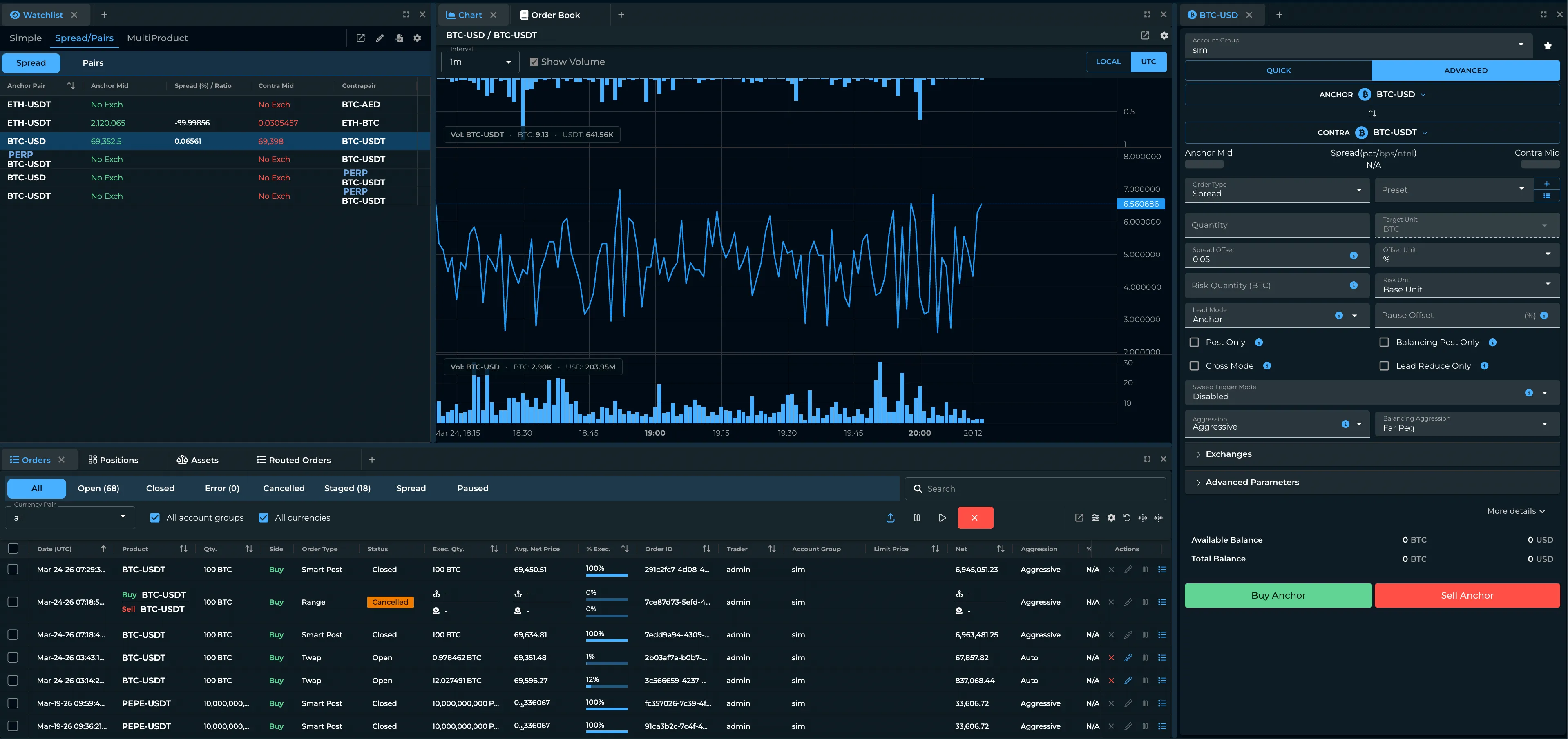
CoinRoutes builds its execution algorithm suite — time-weighted, scheduled, time-paced, percentage-of-volume, passive-posting, sweeping, spread, and pairs strategies — directly on top of a consolidated, fee-adjusted order book and patented smart order routing spanning many CeFi and DeFi venues. Adjustable aggression levels and configurable parameters let traders adapt each algorithm to live conditions, and the platform's guidance emphasizes that algorithms are tools to support execution judgment, not replace it. Internals are kept proprietary; the documentation explains what each algorithm does and when to use it.
Markets are dynamic; the right algorithm and settings depend on real-time conditions. Algorithms support execution but do not guarantee outcomes.
Frequently asked questions
What is algorithmic trading in crypto? The use of automated, rules-based execution algorithms — such as TWAP, VWAP, POV, and Implementation Shortfall — to work orders intelligently across venues, reducing slippage and market impact.
How is crypto algo trading different from equities or FX? The concepts are shared, but crypto has no consolidated tape, runs 24/7 with no session close, has fragmented liquidity across CeFi and DeFi, and has varied fee and settlement models — so algorithms must be rebuilt on a consolidated, fee-aware, multi-venue foundation.
Can I use the same VWAP algorithm I use in equities? The concept transfers, but the implementation can't assume a session volume curve or daily close. Crypto VWAP must work in a continuous market using aggregated data.
Is algorithmic execution the same as automated trading strategies? No. Execution algorithms focus on how to trade a decision well. Automated trading strategies decide what to trade. This article focuses on execution.
Want crypto-native execution algorithms built on consolidated liquidity? Book a demo to explore the CoinRoutes algorithm suite.
Related reading: Crypto Execution Algorithms Explained · What Is Smart Order Routing (SOR) in Crypto? · What Is a Consolidated Crypto Order Book (CBBO)?