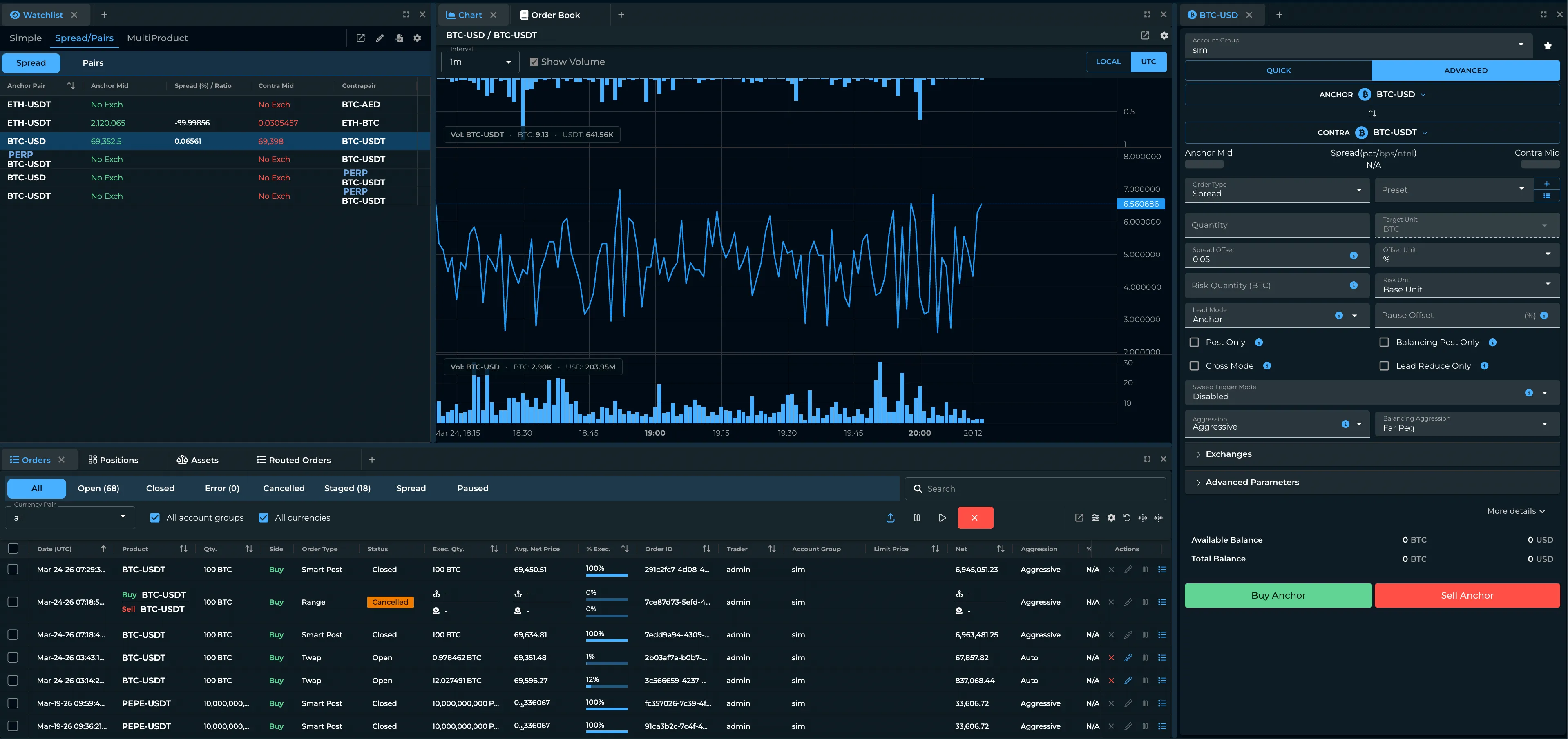
Smart order routing (SOR) is the automated process of deciding where, how, and in what size to send a trade so it executes at the best available price across many trading venues at once. In crypto, where liquidity is split across dozens of centralized exchanges, OTC desks, and decentralized venues, each with its own prices, fees, and order books, SOR is the engine that turns that fragmentation into a single, optimized execution.
CoinRoutes pioneered smart order routing for digital assets and holds a patent covering its approach to consolidated, cost-aware routing across crypto markets.
Why crypto needs smart order routing
In traditional equities, a national market system links exchanges and publishes a consolidated quote. Crypto has no such central tape. The price of BTC-USD on one venue can differ meaningfully from another at the same instant, and the effective price you pay depends on each venue's maker/taker fees, available depth, and how much your own order moves the market.
A trader sending a large order to a single exchange faces three problems at once: the best headline price may sit on a different venue, the displayed size may be too thin to fill the whole order without slippage, and fees can quietly erode the result. SOR solves all three by treating every connected venue as part of one pooled, fee-adjusted order book.
How smart order routing works
At its core, an SOR engine continuously answers one question: given everything I can see across all venues right now, what is the cheapest way to complete this trade?
To do that, a strong SOR system performs several steps in real time:
Consolidate liquidity. It aggregates live order books from every connected venue into a single view, often called a Consolidated Best Bid and Offer (CBBO).
Adjust for true cost. Headline prices are normalized for trading fees, so the engine compares the net cost of executing on each venue, not just the quoted price.
Decide size and venue. The order is split into child orders sized to the depth available at each price level, routing to wherever the next-best fill lives.
Adapt continuously. As books update, fills come back, and prices move, the router re-evaluates and redirects remaining quantity.
This is fundamentally different from simply "checking a few exchanges." Effective routing accounts for liquidity depth, fee tiers, and market impact simultaneously, and it does so faster than any manual desk could.
SOR and best execution
For institutions, SOR is not just a convenience, it is the operational backbone of a best-execution policy. Regulators and clients increasingly expect firms to demonstrate that they took reasonable steps to obtain the best possible result for an order. A routing engine that documents why each child order went where it did provides exactly that evidence trail, which feeds directly into transaction cost analysis (TCA) and compliance reporting.
SOR vs. a single-venue order
Dimension | Single-venue order | Smart order routing |
|---|---|---|
Liquidity accessed | One order book | Consolidated across all connected venues |
Price basis | Quoted price on one exchange | Best net price after fees, across venues |
Large-order handling | Sweeps one book, causing slippage | Splits across venues to limit market impact |
Fee optimization | Manual / none | Built into routing decisions |
Best-execution evidence | Limited | Auditable routing trail |
How CoinRoutes approaches SOR
CoinRoutes builds smart order routing on a consolidated order book spanning a broad set of exchanges, market makers, and DeFi venues. Routing decisions are fee-aware and depth-aware, and they power the platform's full suite of execution algorithms, from passive posting strategies to liquidity-sweeping orders. The same routing intelligence underpins execution quality measurement, so clients can see how their fills compared to the market at the time of trade.
The result is a single point of access to fragmented crypto liquidity, designed for institutional traders, asset managers, proprietary trading firms, and agency desks.
Frequently asked questions
What does smart order routing actually do? It automatically decides which venues to send an order to, and in what sizes, to achieve the best available price after fees — splitting a single order across multiple exchanges when that produces a better result.
Is SOR the same as an execution algorithm? No. SOR is the routing layer that finds and accesses the best liquidity. Execution algorithms (like TWAP or POV) sit on top of it, controlling when and how fast an order works while relying on the router to find the best venue for each slice.
Why can't I just trade on the exchange with the best price? The "best price" is a moving target that lives on different venues at different moments, displayed depth is often too thin for institutional size, and fees differ by venue. SOR continuously solves for the best net outcome across all of them.
Does smart order routing help with best execution compliance? Yes. Because routing decisions are made on a consolidated, fee-adjusted view and can be logged, SOR provides the evidence trail institutions need to demonstrate best execution.
See CoinRoutes' patented smart order routing in action. Book a demo to see how consolidated, fee-aware routing performs on your order flow.
Related reading: What Is a Crypto Execution Management System (EMS)? · What Is a Consolidated Crypto Order Book (CBBO)? · What Is Liquidity Aggregation Across Crypto Venues? · What Is Best Execution in Crypto?