Crypto Execution Algorithms Explained: TWAP, VWAP, POV, Implementation Shortfall
CoinRoutes
Execution algorithms automate how a large order works in the market — splitting it into smaller pieces and timing them to balance speed, price, and market impact. The four most common families are TWAP (time-weighted), VWAP (volume-weighted), POV (percentage of volume), and Implementation Shortfall (arrival-price-driven). Each optimizes for a different objective. This guide explains them in plain terms and shows when each fits.
Why execution algorithms exist
Sending a large order to the market all at once causes slippage and market impact. Execution algorithms solve this by breaking the parent order into child orders and releasing them according to a strategy, so the order blends into natural market activity instead of overwhelming it. The trader sets the objective; the algorithm handles the mechanics.
TWAP — Time-Weighted Average Price
TWAP spreads an order evenly across a defined time window. If you want to buy over four hours, TWAP releases roughly equal portions at regular intervals, aiming for an average price close to the time-weighted average over that period.
Optimizes for: predictable, even execution over time.
Best when: you want to minimize impact and have a clear time horizon, without trying to predict volume.
Tradeoff: because it ignores volume, TWAP may trade too much during quiet periods or too little during active ones.
VWAP — Volume-Weighted Average Price
VWAP aims to match the volume-weighted average price over a period by trading more when the market is more active. It front- or back-loads execution to track the market's natural volume curve, so the order participates in proportion to how the market is actually trading.
Optimizes for: tracking the market's average price; a classic benchmark for "fair" execution.
Best when: you want to execute in line with the day's natural volume distribution.
Tradeoff: depends on a volume forecast; unusual volume patterns can cause deviation.
POV — Percentage of Volume
POV ties execution to a target share of live market volume — for example, "be 10% of volume." When the market trades more, the algorithm trades more; when activity slows, it slows too, keeping a constant participation rate.
Optimizes for: staying proportional to real-time liquidity.
Best when: you want to control footprint relative to the market rather than to the clock.
Tradeoff: completion time is uncertain — if volume is low, the order takes longer.
Implementation Shortfall — Arrival Price
Implementation Shortfall (IS) minimizes the gap between the price when the order arrived (the decision price) and the final average execution price. It balances two opposing costs: trading fast increases market impact, while trading slowly increases the risk of the price drifting away. IS algorithms dynamically trade off impact against timing risk to minimize total shortfall.
Optimizes for: the lowest total cost versus the arrival price.
Best when: the decision price is your benchmark and you want to manage impact and timing risk together.
Tradeoff: more complex; behavior depends on volatility and urgency settings.
Comparison at a glance
Algorithm | Benchmark / goal | Paces against | Completion time | Best for |
|---|---|---|---|---|
TWAP | Time-weighted avg price | The clock | Fixed window | Even, predictable execution |
VWAP | Volume-weighted avg price | Volume curve | Defined period | Tracking market average |
POV | % of market volume | Live volume | Variable | Controlling footprint |
Implementation Shortfall | Arrival price | Impact vs. timing risk | Adaptive | Minimizing total cost vs. decision price |
How crypto changes things
These algorithms originated in equities and FX, but crypto adds complexity: liquidity is fragmented across many venues, markets run 24/7 (no official open/close or session volume curve), and volatility is higher. As a result, a crypto execution algorithm is only as good as the consolidated liquidity and routing beneath it — the algorithm decides how fast to trade, while smart order routing decides where each slice goes for the best net price. (See the companion article on how crypto algos differ from equities/FX algos.)
How CoinRoutes implements execution algorithms
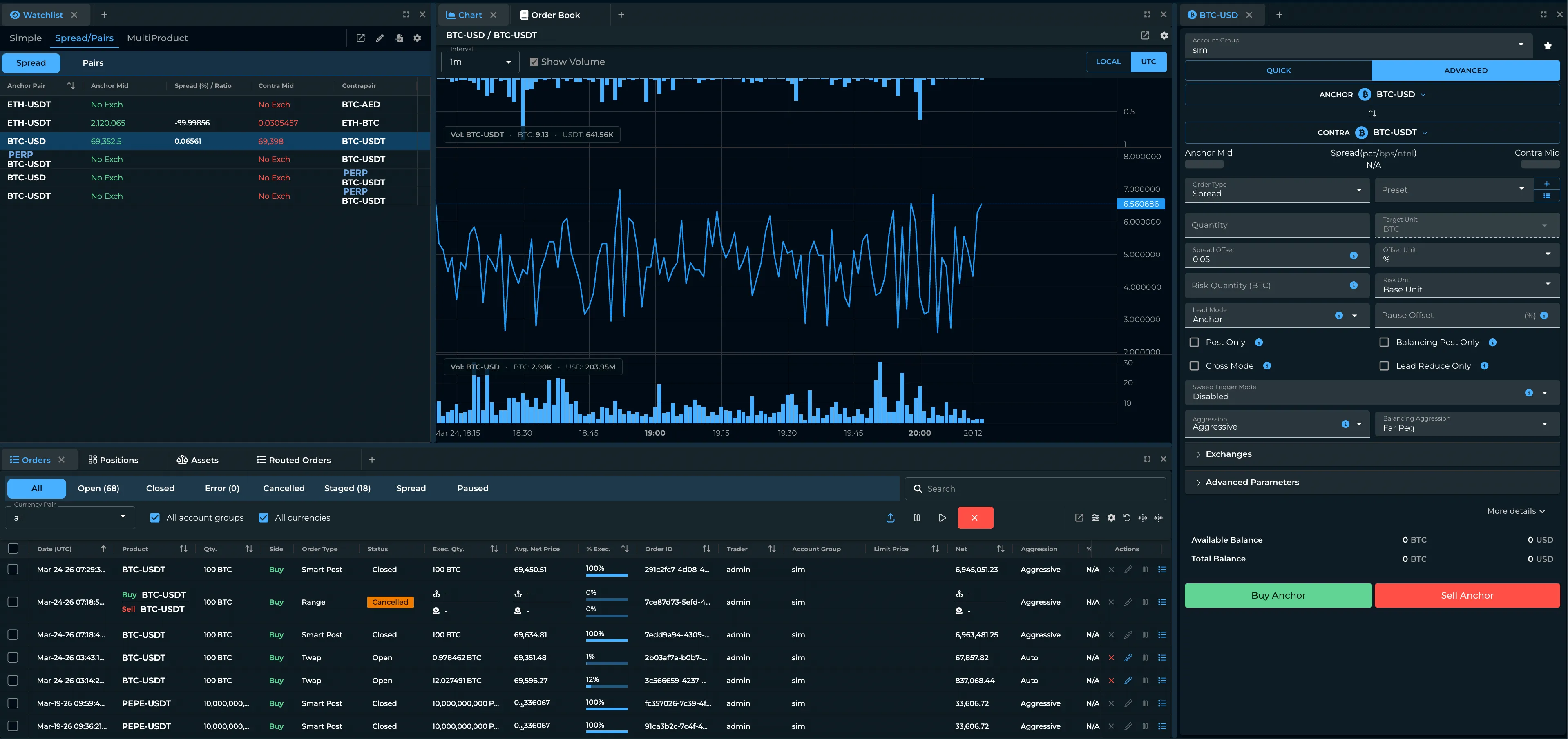
CoinRoutes offers a full execution algorithm suite — including time-weighted (TWAP), scheduled and time-paced strategies, percentage-of-volume (POV), passive posting (Smart Post), liquidity-sweeping, spread, and pairs strategies — all running on top of its consolidated order book and smart order routing. Adjustable aggression levels and configurable parameters let traders tailor each algorithm to current conditions, while execution-quality measurement shows how each performed against benchmarks. The platform's documentation deliberately describes what each algorithm does and when to use it, rather than exposing proprietary internals.
Markets are dynamic; the right algorithm and settings depend on real-time conditions. Algorithms support execution but do not guarantee outcomes.
Frequently asked questions
What is the difference between TWAP and VWAP? TWAP spreads an order evenly over time regardless of volume; VWAP weights execution toward periods of higher market volume to track the volume-weighted average price.
When should I use a POV algorithm? Use POV when you want your order to stay a constant percentage of market volume — trading more when liquidity is high and less when it's low — and you can tolerate a variable completion time.
What does Implementation Shortfall minimize? It minimizes the difference between the price at the moment you decided to trade (arrival price) and your final average execution price, balancing market impact against timing risk.
Do these crypto algorithms work the same as in equities? The concepts are the same, but crypto's fragmented liquidity, 24/7 markets, and higher volatility mean the algorithms must rely on consolidated data and multi-venue routing to perform well.
Want to put these algorithms to work on your order flow? Book a demo to explore the CoinRoutes algorithm suite.
Related reading: What Is Algorithmic Trading for Crypto? · What Is Slippage? · What Is Market Impact? · How Institutions Measure Execution Quality