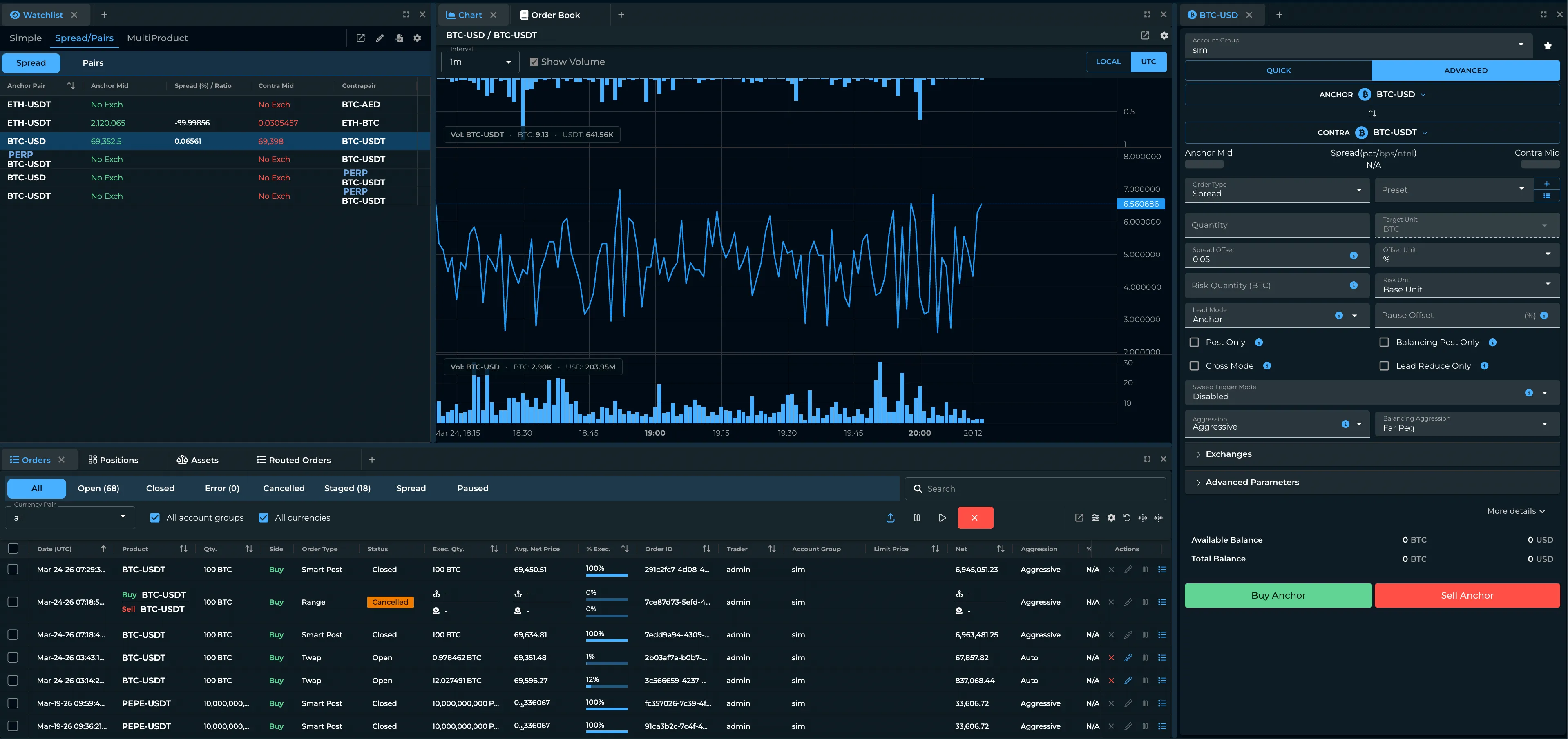
Liquidity aggregation is the practice of combining the tradeable liquidity from many crypto venues — exchanges, market makers, OTC desks, and DeFi pools — into a single source that a trader can access and execute against from one place. Where a consolidated order book is about seeing the whole market, liquidity aggregation is about trading against all of it at once. For institutions, it is the difference between accessing a fraction of the market and accessing the whole of it.
Why crypto liquidity is fragmented
Crypto has no central marketplace. Liquidity is scattered across dozens of centralized exchanges, a growing set of electronic market makers and OTC desks, and on-chain DeFi venues — each siloed, each with its own prices, depth, fees, and connectivity. A trader who connects to only one venue sees only that venue's slice of the market. The total available liquidity for an asset is the sum across all of them, but reaching it requires connecting to, normalizing, and executing across all of them simultaneously.
That is the job liquidity aggregation does.
Aggregation vs. a consolidated order book
These two concepts are tightly related but distinct:
A consolidated order book / CBBO is the data layer — a unified view of prices and depth across venues.
Liquidity aggregation is the execution layer — the ability to actually route and fill orders against all those venues as if they were one pool.
You need the consolidated view to know where liquidity is; you need aggregation (and smart order routing) to act on it. Together they turn fragmented markets into a single, tradeable whole.
What liquidity aggregation includes
A robust aggregation layer typically spans several venue types:
Venue type | What it contributes |
|---|---|
Centralized exchanges | Deep central limit order books for spot and derivatives |
Market makers / LPs | Streaming quotes and principal liquidity, often via RFQ or RFS |
OTC desks | Block liquidity for large size with minimal market impact |
DeFi venues | On-chain liquidity pools and decentralized order books |
Pulling these together requires normalizing different symbologies, fee structures, settlement models, and connectivity protocols into one consistent interface.
Why institutions need it
Aggregated liquidity directly improves execution in several ways:
Better pricing. Accessing the best bid/offer across all venues yields tighter effective spreads than any single venue.
More depth. Large orders can draw on combined liquidity, reducing slippage and market impact.
Resilience. If one venue is thin, congested, or down, others can fill the order.
One workflow. Traders manage one connection and one interface instead of dozens.
Better execution evidence. Routing across aggregated liquidity supports best-execution documentation.
The larger the order, the more these advantages compound — which is why liquidity aggregation is central to institutional crypto trading.
Aggregation, routing, and algorithms
Liquidity aggregation is the foundation; smart order routing and execution algorithms sit on top. Aggregation makes all the liquidity reachable, routing decides which venues get each slice for the best net price, and algorithms control the pace and style of execution. Remove the aggregation layer and the routing and algorithms have far less to work with.
How CoinRoutes aggregates liquidity
CoinRoutes aggregates liquidity across a broad set of centralized exchanges, market makers and liquidity providers, OTC counterparties, and DeFi venues, presenting it through a single consolidated, fee-adjusted order book. Its patented smart order routing then executes against that aggregated liquidity — splitting orders across venues to capture the best net price and minimize impact — while the algorithm suite controls execution style. The platform also supports RFQ workflows for sourcing principal liquidity from market makers and OTC desks.
Frequently asked questions
What does liquidity aggregation mean in crypto? It means combining the tradeable liquidity from many venues into one accessible pool, so a trader can execute against the whole market from a single interface rather than venue by venue.
How is liquidity aggregation different from a consolidated order book? A consolidated order book is the unified view of prices and depth across venues. Liquidity aggregation is the ability to actually execute against all those venues as one pool. You need both.
Does liquidity aggregation include OTC and DeFi? A comprehensive aggregation layer spans centralized exchanges, market makers, OTC desks, and DeFi venues — each contributing different kinds of liquidity, from deep order books to block trades to on-chain pools.
Why does aggregation matter more for large orders? Large orders exhaust a single venue's depth and cause slippage and impact. Drawing on aggregated liquidity across many venues spreads the order out, improving price and reducing footprint.
Access the whole crypto market from one place. Book a demo to see CoinRoutes' liquidity aggregation in action.
Related reading: What Is a Consolidated Crypto Order Book (CBBO)? · What Is Smart Order Routing (SOR) in Crypto? · What Is an RFQ Workflow in Crypto OTC Trading? · CeFi vs DeFi Execution for Institutions