What Is Portfolio and Risk Management Software for Digital Assets?
CoinRoutes
Portfolio and risk management software gives institutions a single, consolidated view of what they hold, what they're exposed to, and how much risk they're carrying — across every exchange, wallet, and custodian. In crypto, where assets are scattered across many venues and instruments and markets never close, this consolidated view is the foundation of disciplined institutional investing and risk control.
What this software does
At its core, it answers three questions continuously: What do we own? What are we exposed to? How much risk is that? To do so, it typically provides:
Position aggregation — a unified picture of holdings across all exchanges, wallets, custodians, and instrument types (spot, perpetuals, futures, options, staked assets).
P&L tracking — realized and unrealized profit and loss across strategies and accounts.
Exposure analysis — net and gross exposure by asset, sector, venue, and strategy.
Risk metrics — measures such as value-at-risk, drawdown, concentration, leverage, and stress/scenario analysis.
Limit monitoring — pre- and post-trade limits with alerts when thresholds are approached or breached.
Reconciliation — matching internal records against venue and custodian balances.
Reporting — consolidated statements for investors, compliance, and management.
Portfolio management vs. risk management
The two are related but distinct. Portfolio management focuses on what you hold and how it's performing — positions, allocations, and returns. Risk management focuses on what could go wrong — exposures, limits, leverage, and the impact of adverse moves. Good software does both: it shows the portfolio and quantifies the risk embedded in it, so managers can act before problems compound.
Why crypto makes this hard
Several features of digital assets complicate portfolio and risk management:
Fragmentation. Holdings spread across many venues and wallets must be aggregated and normalized into one view.
24/7 markets. Risk doesn't pause overnight or on weekends; monitoring must be continuous.
Volatility. Sharp moves can change exposures and breach limits quickly, demanding real-time metrics.
Instrument complexity. Spot, perpetuals with funding, dated futures, options, and staked or locked assets each carry different risk profiles.
Custody diversity. Assets held in self-custody, on exchanges, and with custodians must all be captured accurately.
Where it fits relative to execution systems
Portfolio and risk software is not the same as an execution system, though they're complementary:
System | Primary question | Time horizon |
|---|---|---|
Portfolio/risk software | What do I hold and what's my risk? | Ongoing / monitoring |
Execution platform (EMS) | How do I trade this well right now? | Real-time / per-order |
The portfolio/risk layer informs what to trade and how much risk to take; the execution layer determines how to trade it. They connect through APIs, with execution feeding fills and positions back into the portfolio view. Pre-trade risk controls often live in both — the execution platform enforcing order-level limits, the portfolio system monitoring aggregate exposure.
Pre-trade risk controls in execution
Risk management isn't only after the fact. Strong execution platforms embed pre-trade controls — checks on order size, price reasonableness, and exposure limits that prevent erroneous or oversized orders from reaching the market. These controls are a first line of defense that complements portfolio-level risk monitoring.
How CoinRoutes fits
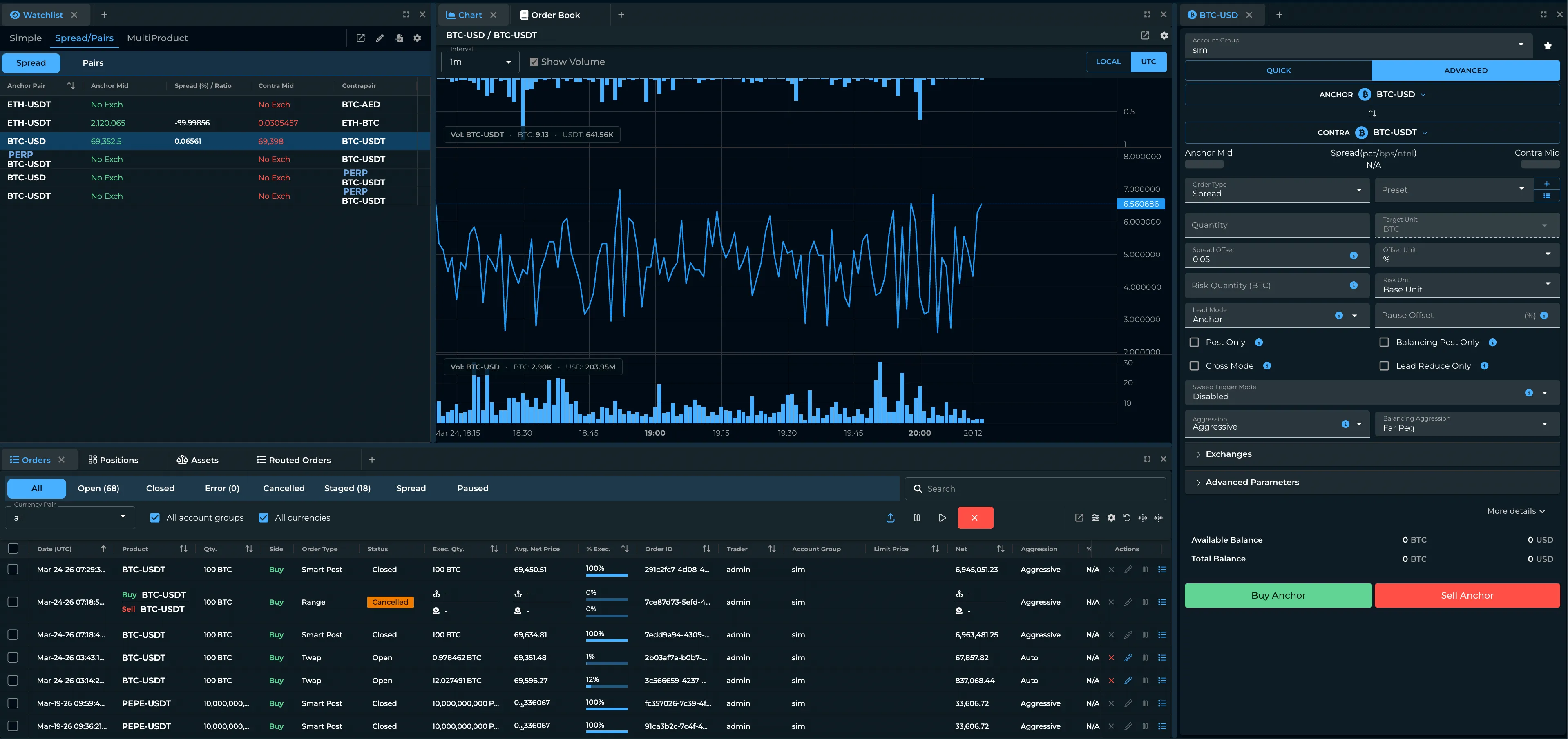
CoinRoutes provides the execution layer and the risk controls around it: consolidated market data, pre-trade risk checks, configurable limits, and strategy/account structures that let institutions organize and permission trading activity. It connects via REST, WebSocket, and FIX, so positions and fills can feed the portfolio and risk systems institutions run alongside it, while the platform enforces order-level risk controls at the point of execution.
This article is general information, not investment or risk-management advice. Institutions should design risk frameworks appropriate to their mandates and consult qualified advisors.
Frequently asked questions
What is portfolio and risk management software for crypto? Software that consolidates an institution's holdings across all venues and wallets, tracks performance and exposures, and quantifies risk through metrics and limit monitoring — giving one accurate picture of the portfolio and its risk.
How is it different from an execution platform? Portfolio and risk software answers "what do I hold and what's my risk?" on an ongoing basis. An execution platform answers "how do I trade this well right now?" in real time. They're complementary and connect via API.
Why is crypto risk management harder than traditional? Holdings are fragmented across many venues, markets trade 24/7, volatility is high, instruments are varied, and custody is diverse — so positions must be continuously aggregated and risk measured in real time.
What are pre-trade risk controls? Checks applied before an order reaches the market — on size, price, and exposure limits — that prevent erroneous or oversized trades. They complement portfolio-level risk monitoring.
Want execution with built-in pre-trade risk controls? Book a demo to see how CoinRoutes fits your risk framework.
Related reading: EMS vs OEMS vs PMS in Crypto · What Is a Crypto Execution Management System (EMS)? · How Institutions Measure Execution Quality