What Is a Crypto Execution Management System (EMS)?
CoinRoutes
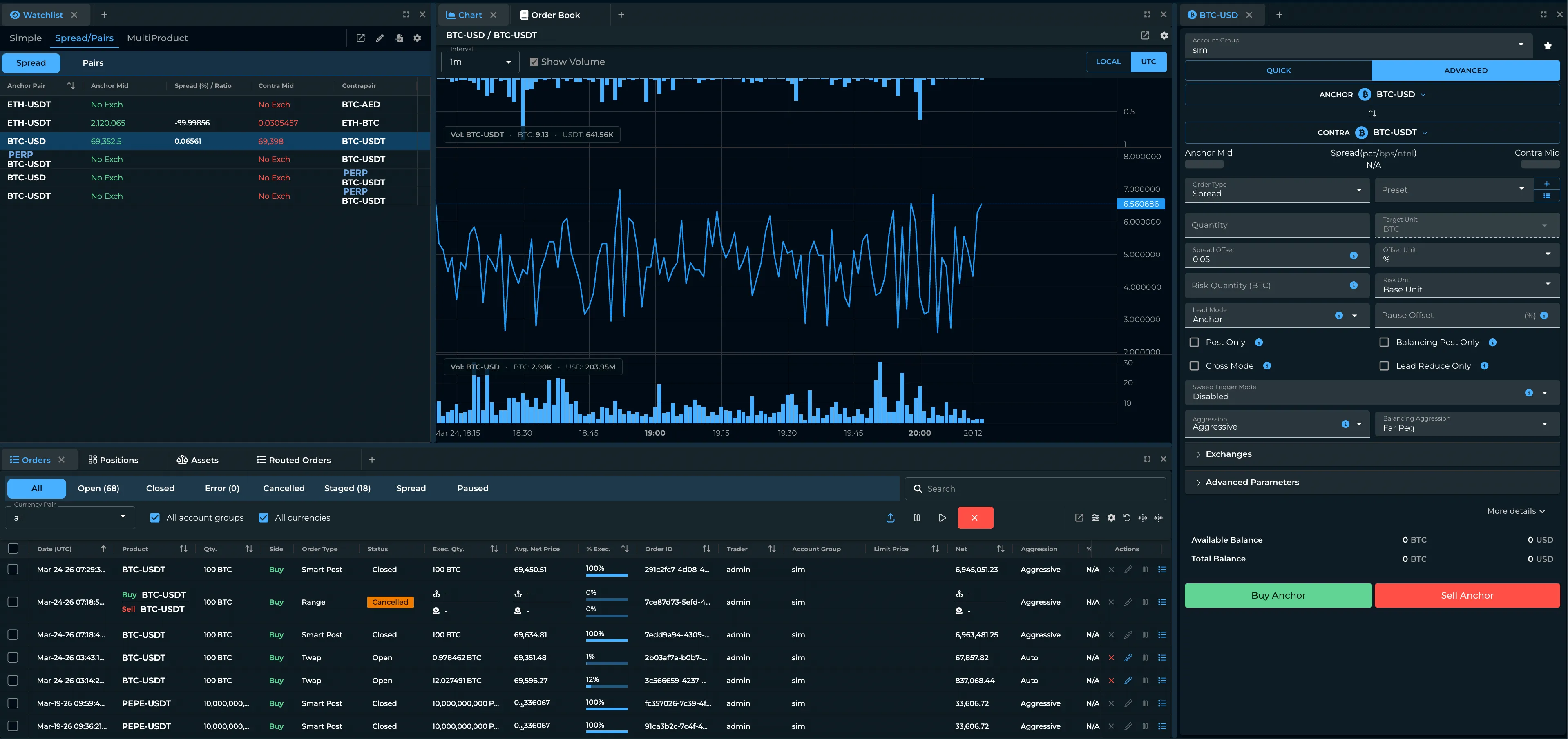
A crypto execution management system (EMS) is the trading software institutions use to access market liquidity, manage orders, and execute trades across many venues from a single interface. It is where the actual work of trading happens: viewing live consolidated market data, selecting an execution strategy, sending orders, and monitoring fills in real time.
For institutional desks operating in digital assets, an EMS is the cockpit that turns fragmented, multi-venue crypto markets into one coherent, controllable trading environment.
What an EMS does
An execution management system sits between the trader and the market. Its job is to make execution fast, controlled, and measurable. A capable crypto EMS typically provides:
Consolidated market data — a unified view of order books and prices across connected exchanges, market makers, and DeFi venues.
Smart order routing — automated routing of orders to the best available liquidity after fees.
Execution algorithms — strategies such as TWAP, POV, and passive posting that control how an order works over time.
Multi-venue connectivity — simultaneous access to many exchanges and liquidity providers through one set of credentials.
Real-time order and position monitoring — live status on working orders, fills, and balances.
Risk controls — pre-trade limits and checks that prevent erroneous or oversized orders.
API access — REST, WebSocket, and FIX connectivity so trading can be automated or integrated into existing systems.
Why institutions use an EMS
Trading crypto at scale without an EMS means logging into many exchange interfaces, manually comparing prices, splitting orders by hand, and stitching together fills afterward. That is slow, error-prone, and nearly impossible to audit.
An EMS replaces that with a single workflow. A trader sees one consolidated book, chooses how aggressively to execute, and lets routing and algorithms handle the mechanics across venues. Crucially, every decision is captured, which feeds execution quality measurement, transaction cost analysis, and best-execution reporting.
The payoff is concentrated in a few areas: better pricing through access to aggregated liquidity, reduced market impact through intelligent order slicing, operational efficiency from one interface instead of many, and a clean compliance trail.
EMS vs. trading directly on an exchange
Capability | Single exchange UI | Crypto EMS |
|---|---|---|
Venues accessible | One | Many, simultaneously |
Market data | One book | Consolidated across venues |
Order routing | Manual | Smart order routing |
Execution algorithms | Limited or none | Full algo suite |
Risk controls | Per-exchange | Centralized, pre-trade |
Connectivity | Web only, typically | REST, WebSocket, FIX |
Execution reporting | Fragmented | Unified, auditable |
Where the EMS fits in the trading stack
An EMS is one layer of a broader institutional toolkit. A portfolio management system (PMS) tracks holdings and strategy-level positions; an order management system (OMS) handles order lifecycle, allocations, and compliance; the EMS is the execution layer that actually works orders in the market. Many platforms blur these lines — see the companion article on EMS vs. OEMS vs. PMS for how the categories overlap in crypto.
How CoinRoutes delivers EMS capabilities
CoinRoutes is an institutional-grade execution platform combining smart order routing, a full suite of execution algorithms, consolidated market data, and broad venue connectivity. Traders can work orders through the UI or integrate via REST, WebSocket, or FIX, with strategy-based account structures, permissioning, and pre-trade risk controls built in. It is designed specifically for institutional traders, asset managers, proprietary trading firms, and agency desks.
Frequently asked questions
What is the difference between an EMS and an exchange? An exchange is a single venue where trades happen. An EMS is software that connects to many exchanges and venues at once, giving traders one place to route orders, run algorithms, and monitor execution across all of them.
Do I need an EMS if I only trade on one exchange? If you trade meaningful size, an EMS still helps through better order handling, risk controls, and execution reporting — but its biggest advantage is unlocking liquidity across multiple venues simultaneously.
Does an EMS execute trades automatically? An EMS provides the tools — routing and algorithms — to automate how orders execute. The trader still decides what to trade and which strategy to use; the EMS handles the mechanics.
Can an EMS connect to my existing systems? Yes. Institutional platforms typically offer REST, WebSocket, and FIX connectivity so the EMS can integrate with order management, portfolio, and risk systems.
See what an institutional crypto EMS feels like to trade on. Book a demo with the CoinRoutes team.
Related reading: EMS vs OEMS vs PMS in Crypto · What Is Smart Order Routing (SOR) in Crypto? · Crypto Execution Algorithms Explained · What Is Algorithmic Trading for Crypto?