Slippage, and how execution algorithms reduce it?
CoinRoutes Research Team
Company
This note defines slippage for institutional orders, decomposes it into its cost components, and shows how execution algorithms and smart order routing reduce it across fragmented digital asset venues. It is written for trading desks that measure execution to the basis point.
DEFINITION: Slippage is realized, not quoted. It is known only after the order is done.
Slippage is the difference between the price you expected when you decided to trade and the average price you actually paid by the time the order finished. On a small retail click it is a rounding error. On an institutional order moving size across fragmented crypto markets, it is often the single largest cost of trading, larger than fees. For hedge funds, asset managers, and proprietary trading firms, it is the starting point for any honest definition of best execution.

Why slippage happens
01 - Rule of thumb: in thin crypto books, market impact often exceeds the quoted spread.
Three forces drive it. First, spread: to trade immediately you cross from the bid to the offer. Second, market impact: a large order consumes the visible liquidity at the best price and reaches into deeper, worse priced levels, a pattern traders call walking the book. Third, timing: while the order works, the market keeps moving, sometimes with you and sometimes against you. In digital assets these forces are amplified, because liquidity is scattered across more than sixty venues, books are thinner than in equities or foreign exchange, and volatility runs higher.

The anatomy of execution cost
02 - Framework: implementation shortfall, Perold (1988),1 adapted for 24/7 venues.
Practitioners break the gap between decision and outcome into components, a framework borrowed from equities and known as implementation shortfall. Spread and market impact are the cost of demanding liquidity right now. Timing, or delay, is the drift between the moment you decide and the moment you trade. Opportunity cost is the part of the order you never managed to fill. Good trade analytics attributes every basis point to one of these buckets, which is the only honest way to know whether an execution was actually good.

How execution algorithms reduce slippage
03 - Schedule based: TWAP, POV. Liquidity providing: passive posting.
Algorithmic trading attacks each component directly. Rather than firing one large market order into a thin book, an algorithm slices the parent order into smaller pieces and works them over time, so no single child order has to walk far up the book. Scheduling strategies such as TWAP and percentage of volume (POV) pace participation to the market instead of overwhelming it. Passive posting captures the spread rather than paying it. And smart order routing spreads each slice across aggregated venues, sending size to wherever the best price and depth actually sit at that instant. The combined effect pulls the average fill back toward the arrival price.

How CoinRoutes fits
IN PRACTICE - CoinRoutes: patented routing over a consolidated book, 60+ venues, CeFi and DeFi.
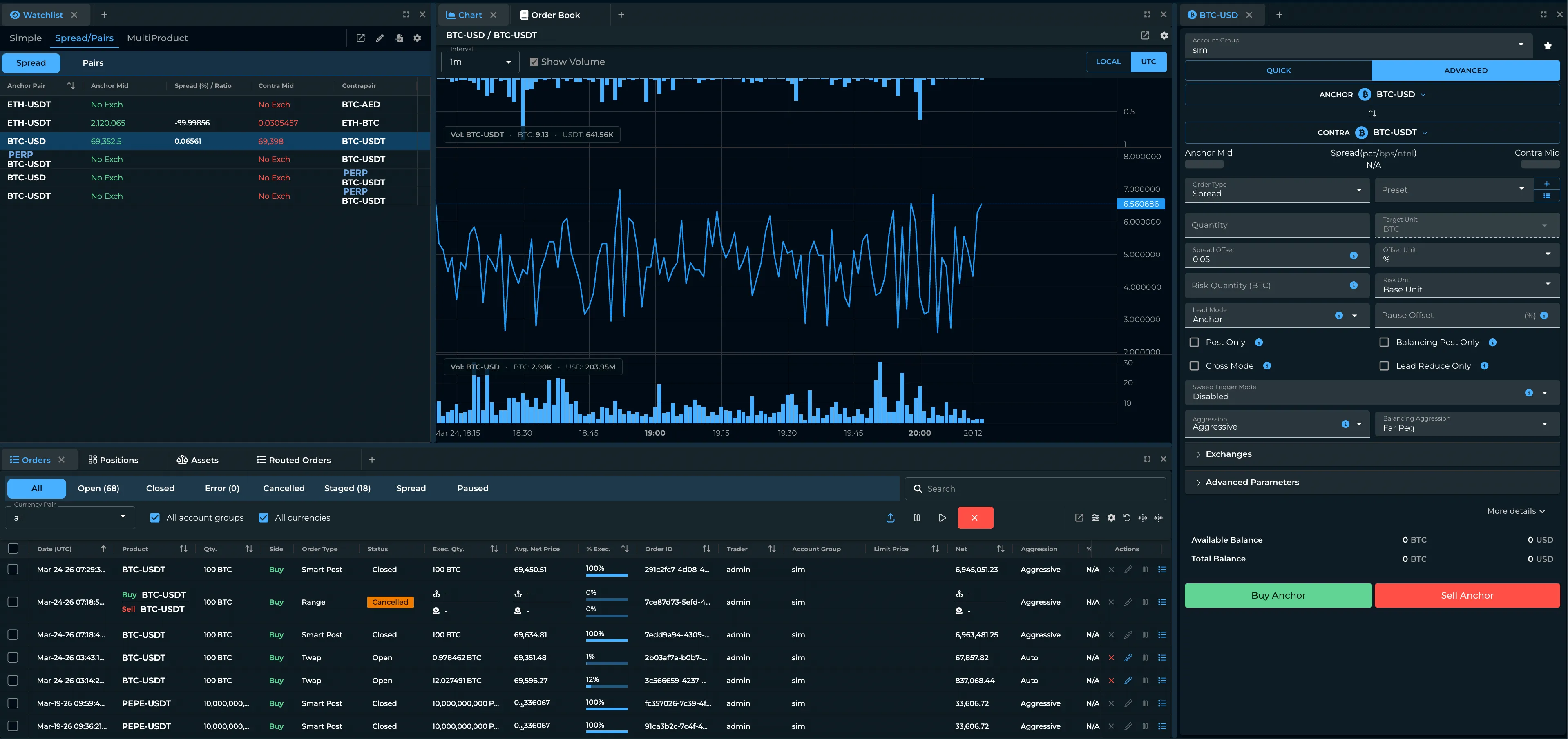
CoinRoutes is an institutional trading platform built for exactly this problem. Its patented smart order routing reads a consolidated order book assembled through liquidity aggregation across more than sixty venues, spanning centralized exchanges, onchain markets, and liquidity providers, then directs automated execution to the venues offering genuine best execution at that moment. A full algo suite, including TWAP, POV, and passive posting strategies, gives traders control over how aggressively to work an order, while built in trade analytics and performance analytics measure realized slippage against arrival price and other benchmarks after every fill. The effect is best execution that institutional investors can prove rather than claim, across the whole of digital assets, from a single execution management system (EMS).
Slippage never disappears entirely. The work of good trading technology is to keep it small, predictable, and measurable, and to give serious electronic trading desks the tools to keep it that way.
Bring your worst fill. We'll show you where the basis points went. Book a demo with the CoinRoutes team.
1 Perold, A. F. (1988), The Implementation Shortfall: Paper Versus Reality, Journal of Portfolio Management 14(3). The framework predates crypto; the components map cleanly onto continuous, around the clock digital asset venues.
Exhibits are schematic and illustrative, intended to convey structure rather than to quote market data. This note is for informational purposes only and is not investment advice.