Hyperliquid's HIP-4: The Margin Architecture Is the Unlock

Matt Whitney
HIP-4 Introduces a New Paradigm in Prediction Markets
Prediction markets are not new. Polymarket and Kalshi clear billions in volume a year. Augur and PredictIt have been running quietly for years. The category is settled.
What is not settled is what happens when outcome contracts stop living in their own walled garden and get dropped into a high-performance derivatives exchange, sharing liquidity, collateral, and the rails that already move billions in monthly volume.
That is the actual significance of HIP-4. And it has almost nothing to do with prediction markets.
HyperCore Represents a Sea Change
Mechanically, HIP-4 is binary outcome contracts: instruments settling to 1 or 0 based on whether some defined thing happened. A contract at 0.42 means a 42% implied probability. Standard stuff.
What is not standard is the neighborhood. The first live market, launched May 2, 2026, is a daily BTC binary settling at 06:00 UTC against the HyperCore mark price. Fully USDC-collateralized, no leverage, no liquidation risk, trading on the same book that chews through roughly 200,000 orders per second. Opening fees: zero. A structural undercut of Polymarket's winner fee and Kalshi's tiered schedule that the competition will eventually have to answer for.
The fee story gets the headlines. It is not the story.
Unlocking the Collateral Trap
On Polymarket or Kalshi, outcome markets are islands. Collateral is trapped. Liquidity gets bootstrapped one contract at a time. Market makers can't efficiently hedge correlated exposure because the hedges live on different venues, under different custodians, behind different APIs that all decided to be incompatible in their own special way. A museum of fragmentation.
On Hyperliquid, these contracts sit inside a functioning derivatives exchange with deep perp liquidity and professional market makers already plugged in. Same matching engine. Same wallet. Same margin account.
Why Institutional Desks Should Care About Unified Margin
Consider the desk long ETH perps into a protocol upgrade, wanting to hedge the tail risk that it ships late, the kind of event that doesn't drift the price, it dislocates it. Legacy setup: perp on Binance or Deribit, binary hedge on Polymarket. Two systems, two collateral pools, two liquidation frameworks. Capital duplicated, correlation rewarded with exactly zero margin relief.
Unified model: both positions sit in the same wallet, settle in the same USDC, feed the same portfolio margin calc. The hedge does its job at the balance sheet level, not just on the P&L line. This is what makes CME's Standard Portfolio Analysis of Risk (SPAN) margin and Deribit's portfolio margin sticky, the mechanism by which sophisticated capital finds its home and refuses to leave. HIP-4 is the first credible attempt to bring that framework fully on-chain.
And the underlying is just a wrapper. BTC, sure. But also WTI above $80 by Friday. SPX at month-end. Gold, EUR/USD, the next FOMC decision. The interesting part isn't the asset list, it's the clock. CME shuts down for maintenance. Equity markets close at 4pm and pretend weekends don't exist.
Hyperliquid does neither. When Israel and Iran were recently trading missile strikes, oil traders waited until Sunday's futures open to find out what the weekend cost them, hours of real risk with no price to trade against. A 24/7 WTI binary strip changes that: continuous price discovery on macro risk factors that today go dark for most of the weekend. Same logic for SPX, rates, and anything else with a settlement feed.
The Options Abstraction Angle, and Why It Loops Back to Margin
Vikram Singh at Galaxy has the sharpest read: a single binary is not an option. A vanilla call pays out more the further the underlying moves past the strike, unlimited upside. A binary pays exactly $1 if the condition is met, zero otherwise. The risk profile is fundamentally different, and replicating call-like exposure with a single binary is using the wrong tool.
A dense strip across adjacent strikes is different. Line up enough binaries, $80, $81, $82, $83, and the combined payoff starts to look like a capped call. Options exposure without the complexity of a volatility surface, just a probability ladder, each rung priced by the market.
The catch is serious. Strips only work when the venue offers portfolio margin, meaning it recognizes that a trader's long and short legs offset each other and reduces collateral requirements accordingly. Without it, every leg has to be collateralized independently, which gets prohibitively expensive fast. Market makers stop quoting, spreads widen, the product dies on the vine. Margin architecture isn't just a hedging win. It's the precondition for outcome contracts to become options-like at all.
What This Means for Institutional Participants and CoinRoutes
HIP-4 rewrites the diligence agenda. How does the venue treat margin offset across perps, spot, and outcomes? How robust is the oracle? And the consequential one: how does routing logic evolve when a single position can be expressed as a perp, an outcome contract, or a synthetic combination of both?
That last question is the one CoinRoutes was built to answer. As outcome contracts, perps, and eventually native options share margin on the same venue, the line between what instrument is this and where should this trade disappears. A capped call on BTC might be a vanilla option on Deribit, an outcome strip on Hyperliquid, and a perps-and-binaries synthetic somewhere else.
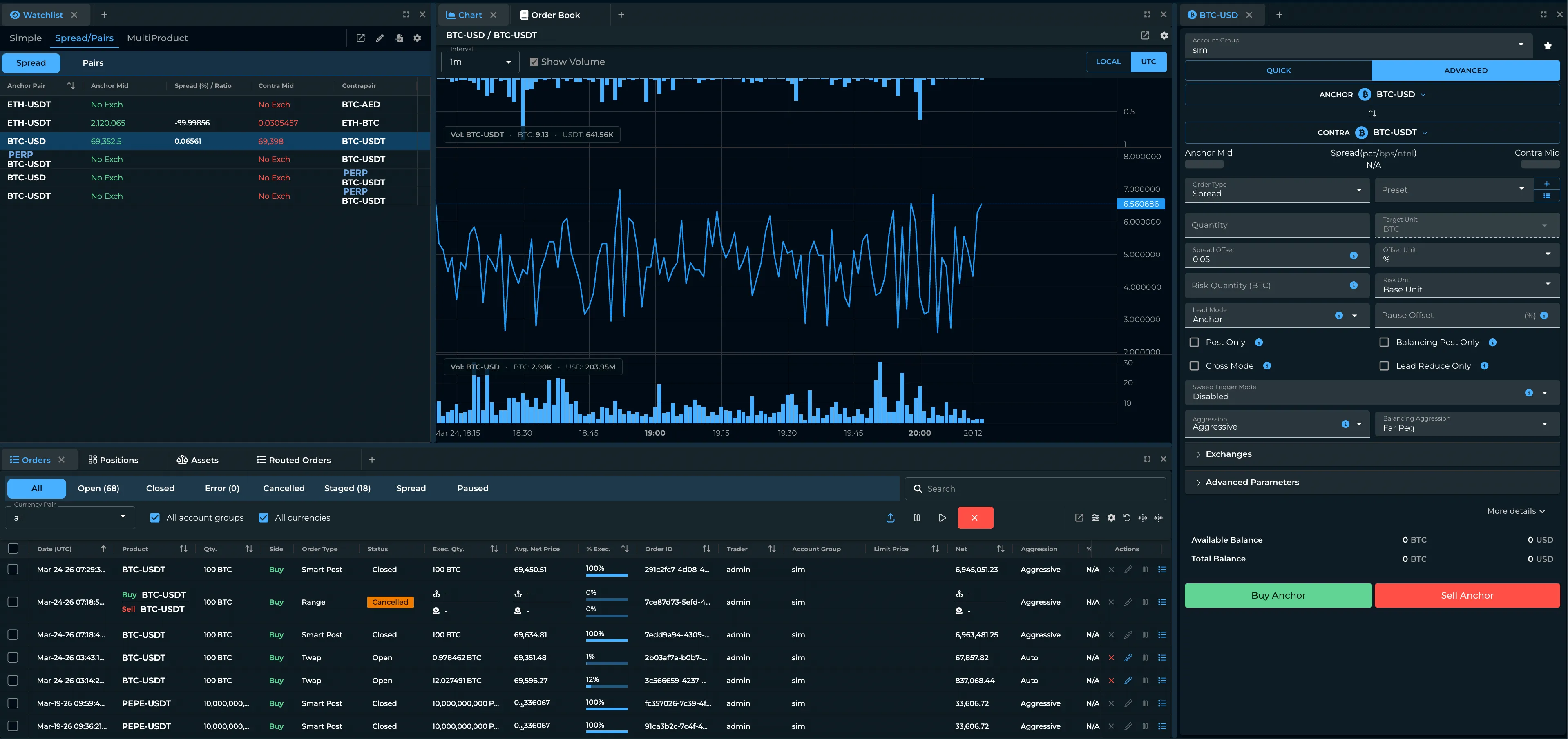
That world needs an execution layer. Trade everything, everywhere…spot, perps, CME futures, options, RWAs, FX, and prediction markets, across 60+ CeFi and DeFi venues in a single order. The spread algorithms institutions already use for basis trades and funding rate arbitrage extend cleanly to perp-plus-binary synthetics. CoinRoutes' upcoming options launch extends our smart order routing into options and the broader convex and bounded-payoff universe HIP-4 opens up , one layer for the whole stack.



Request a demo
Find out how CoinRoutes can simplify the way you interact with digital asset markets.