Institutions executing crypto trades face a choice between two market structures. CeFi (centralized finance) means trading on centralized exchanges and with OTC desks that operate order books and custody assets; DeFi (decentralized finance) means trading on-chain through smart contracts and liquidity pools, where you keep custody of your own assets. Each carries distinct tradeoffs in liquidity, custody, settlement, cost, and risk. This guide compares them.
How execution works in each model
CeFi execution happens on centralized venues that run a central limit order book (or quote streams), match trades off-chain in their systems, and custody user balances. Trading is fast, familiar, and supports advanced order types and algorithms. The institution typically holds assets at the venue or accesses them through a custodian, and trusts the venue to match and settle correctly.
DeFi execution happens on-chain. Trades settle through smart contracts — often automated market makers (AMMs) that price trades against liquidity pools, or on-chain order books. The trader retains custody of assets in their own wallet until the moment of execution, and the transaction settles on the blockchain. There is no central operator holding funds.
The core tradeoffs
Dimension | CeFi | DeFi |
|---|---|---|
Custody | Venue/custodian holds assets | Self-custody until execution |
Counterparty risk | Venue solvency/security | Smart contract risk |
Liquidity depth | Generally deeper, esp. majors | Growing; varies by pool |
Speed | Fast (off-chain matching) | Bound by block times |
Cost | Trading fees | Trading fees + gas + potential MEV |
Pricing | Order book / quotes | AMM curves or on-chain books |
Transparency | Venue-reported | Fully on-chain, auditable |
Access control | KYC / accounts | Permissionless (often) |
Where each shines
CeFi advantages: deeper liquidity for large size in major pairs, faster execution, mature order types and algorithms, and familiar operational and reporting workflows. The cost is counterparty risk — assets sit with a venue you must trust.
DeFi advantages: self-custody (you don't hand assets to a venue), full on-chain transparency, permissionless access, and exposure to assets and pools that may not exist on centralized venues. The costs are different risks: smart contract vulnerabilities, gas fees, slippage on thinner pools, and MEV (maximal extractable value), where transaction ordering can be exploited to a trader's disadvantage.
Execution challenges unique to DeFi
DeFi introduces considerations CeFi traders may not be used to: transactions are public before they confirm, exposing them to front-running and sandwich attacks (forms of MEV); AMM pricing means slippage scales steeply with trade size relative to pool depth; and gas costs add a variable execution expense. Institutions executing in DeFi often use protective measures like slippage limits, private transaction routing, and careful pool selection.
Why institutions increasingly execute across both
The practical reality is that the best execution for a given order may live in either world — or both. Major pairs in size often execute best on deep CeFi venues; certain assets, yields, or strategies are only available in DeFi. Treating CeFi and DeFi as a single accessible liquidity universe, rather than separate silos, lets institutions route each order to wherever the best net result is — which is exactly the problem liquidity aggregation and smart order routing address.
How CoinRoutes spans CeFi and DeFi
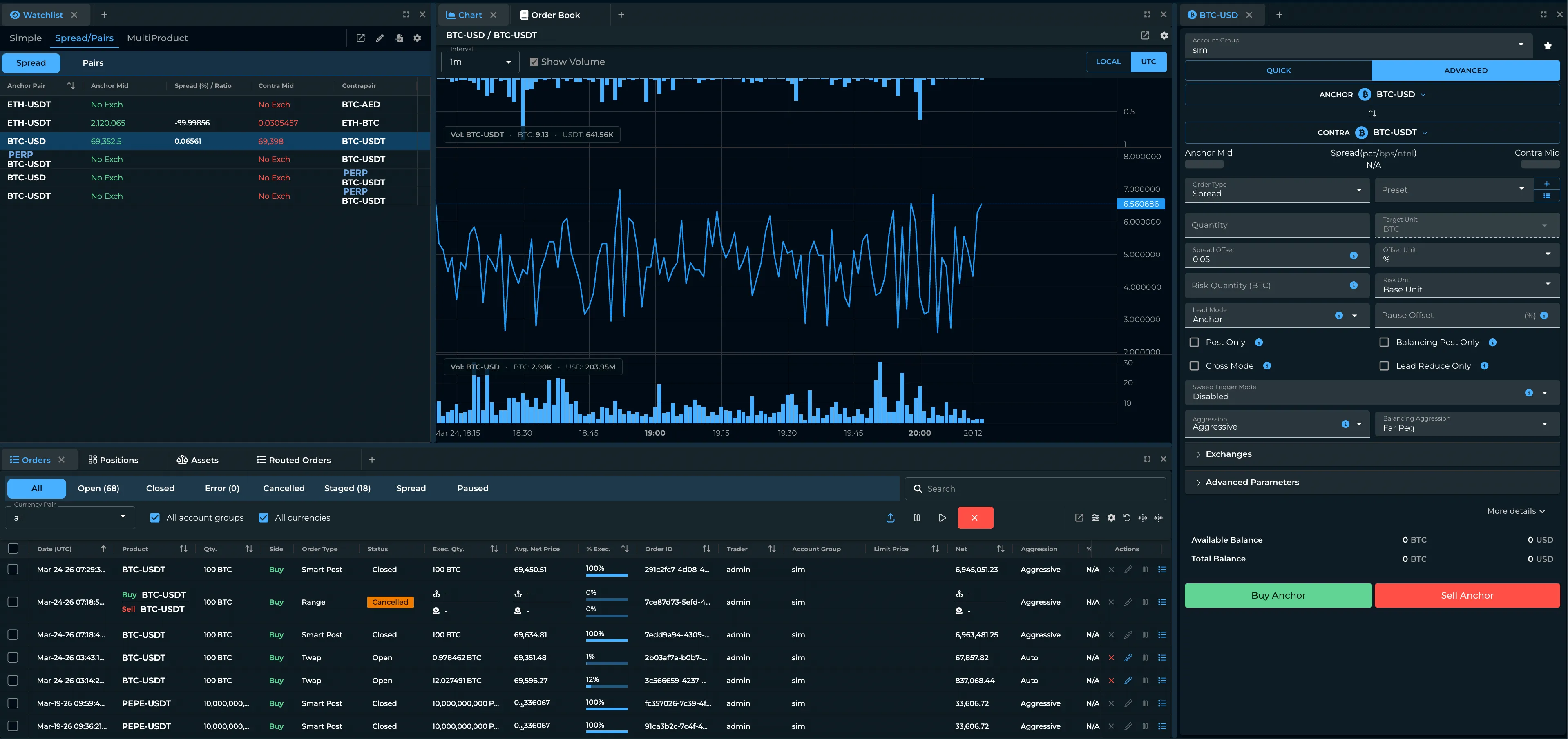
CoinRoutes connects to both centralized venues (exchanges, market makers, OTC desks) and DeFi venues, aggregating their liquidity into a single consolidated, fee-adjusted order book. Its smart order routing can then seek the best net execution across both worlds, while the algorithm suite controls execution style. This lets institutions access CeFi and DeFi liquidity through one interface rather than managing them as separate environments.
This article is general information, not investment, legal, or security advice. CeFi and DeFi each carry distinct risks; institutions should perform their own due diligence.
Frequently asked questions
What is the main difference between CeFi and DeFi execution? CeFi trades on centralized venues that hold your assets and match trades off-chain; DeFi trades on-chain through smart contracts while you keep custody until execution. The key tradeoff is custody and counterparty risk versus smart contract risk.
Is DeFi or CeFi better for large institutional trades? Large trades in major pairs often find deeper, faster liquidity on CeFi venues, but the best path depends on the asset and order. Many institutions route across both to find the best net result.
What is MEV, and why does it matter in DeFi? MEV (maximal extractable value) refers to value extracted by reordering or inserting transactions — e.g., front-running. Because DeFi transactions are public before confirming, large trades can be exploited, so traders use protections like slippage limits and private routing.
Can one platform execute across both CeFi and DeFi? Yes. Platforms that aggregate liquidity from both centralized and decentralized venues can route orders to wherever the best net execution is, treating the two as one accessible market.
Want to route across CeFi and DeFi from one interface? Book a demo to see how CoinRoutes aggregates both.
Related reading: What Is Liquidity Aggregation Across Crypto Venues? · Custody Models for Institutions · What Is Smart Order Routing (SOR) in Crypto?