
Authors: Michael Holstein, Co-Founder; Carl Savage, Head of Algorithmic Research
Avoiding paying fees feels good, until the market starts moving away from you. Or put another way, the cost of waiting is higher than the cost of trading.
Passive trading is a common strategy employed by millions of traders, both retail and institutional, often for lack of a better option. Crypto Exchanges like Binance, Coinbase, OKX, and Bybit provide these strategies at no additional cost, called peg orders. The way peg orders work, as the market price moves, your order price is automatically changed by the exchange to join the inside price in the exchange’s consolidated order book (“CLOB”). The idea of a peg order is to never pay taker fees, never pay the spread, and be the most marketable price available that is displayed. In theory, this sounds great. However, the problem is that the peg order type is only optimized for a single condition: price. In slow markets, where the price doesn’t move, the strategy works fine. But in fast or imbalanced markets, strictly passive order placement can introduce massive costs.
CoinRoutes designed an algorithm to optimize for BOTH fees and performance
CoinRoutes designed the SmartPost™ algorithm in 2017 to minimize total execution cost, by optimizing for two conditions instead of just one. In order to optimize for two conditions instead of just one - both fees and best price, this required building a sophisticated signal that predicts for very short term market price changes. If the price isn't likely to move in the near future, post a passive order. If the price is likely to move against you more than the spread combined with the fee for taking, then cross the spread immediately. SmartPost™ default settings work across the entire suite of CoinRoutes’ algorithms, including TWAP, Volume Participation (VWAP), Spread, etc.
Where post-only or pegging algorithms fall short
Simple pegging, post-only orders perform best in stable, balanced order books. When the book becomes one-sided, ie. when buy pressure significantly outweighs available sell liquidity, a passive, pegged buy order doesn’t maintain an acceptable participation rate. The result of NOT trading when the price action is unfavorable is referred to as “opportunity cost”. Since your buy order wasn’t willing to cross the spread, and the price moved higher, the order didn’t fill, and you lost the “opportunity” to buy at lower prices.
In these environments, limit and peg orders are either left behind as the market moves or are repeatedly repriced higher by a pegging instruction. While this approach may reduce maker fees, it often results in worse realized prices as the strategy ends up chasing the market without filling at acceptable participation rates. For institutional traders, this is often referred to as “slippage”. If you measure your completed order’s average price against benchmarks like arrival price and VWAP price, and you come up with a very large negative number, you’re “leaking alpha”, and those bad trades can really impact overall portfolio performance. Bad trades like this can be avoided, but only by using a sophisticated algo with in-built price predictive signals like CoinRoutes’ SmartPost™.
What the data shows
Our Trade Cost Analysis highlights this effect clearly. Across the same instruments, venues, and time periods, orders submitted with post-only constraints like pegging, on the balance show higher slippage than orders that allow SmartPost™ to take liquidity when needed. This pattern is especially visible during periods of constrained liquidity or elevated volatility.
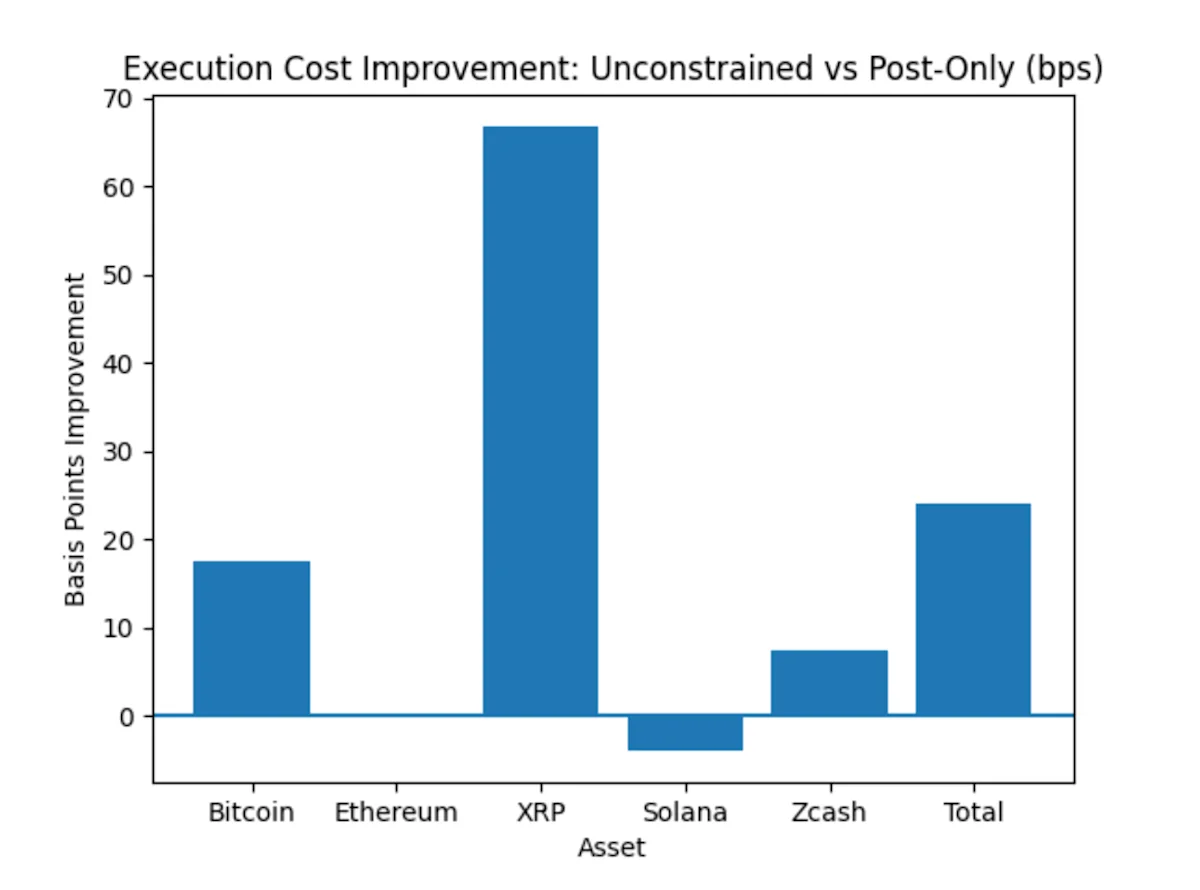
Using the last four weeks of data, comparing post only orders to SmartPost™ orders shows significant outperformance of SmartPost™. Looking at Perpetual Futures, unconstrained orders outperformed post-only orders by over 24 basis points. In this sample, for the month of January, we counted over 180,000 post only orders, for $690 Million in value and over 9,100 unconstrained SmartPost™ orders for over $3.78 Billion in value.
Overall, allowing SmartPost™ to opportunistically take liquidity and cross the spread resulted in executing orders faster and improved performance significantly. These improvements remain even after accounting for taker fees and spread costs, particularly in trending or one-sided markets. The result of using SmartPost™ versus using a simple peg order results in measurably better execution quality. This benefit is maintained across a wide range of market and volatility regimes.
Why taking liquidity opportunistically can produce significant performance gains
SmartPost™ signal logic evaluates real-time order book pressure, queue positioning, and short-term price movement. SmartPost™ is designed to adapt dynamically to changing liquidity and price conditions equally. When the likelihood of opportunity cost increases, the algorithm can choose to send a marketable order instead of continuing to post passively.
Although this means paying taker fees and crossing the spread, the algorithm is aware of both taker fee to maker fee difference, and spread distance. Before sending the order (“pre-trade”) the algorithm compares the cost of spread crossing to the projected cost of waiting, by using a quantitatively derived estimate of likely short term price movement. In other words, paying the spread is cheaper than missing a big price move. This behavior ensures that the order will maintain an acceptable and consistent volume participation rate, which significantly decreases the impact of time based price volatility. In trending and volatile markets, decreasing participation rate (and increasing the time to fully execute the order) significantly increases the probability that the price will move against you, which would in turn either force the trader to cancel their order and miss the opportunity to enter or exit a position, or if forced to fill, causes significant slippage and destruction to price performance, by missing the opportunity to fill at better prices.
Your algorithm should adapt to market conditions proactively, not reactively
Markets change quickly. Your trading algorithm needs to adjust even faster.
CoinRoutes’ SmartPost™ adapts dynamically by using CoinRoutes’ proprietary price signal, dynamically alternating between posting and taking liquidity as market and liquidity conditions require. This balance between liquidity provision and liquidity taking is core to modern algorithmic execution, and requires that best execution include trading on exchanges, because of their central limit order book (“CLOB”) structure. Upon client demand, CoinRoutes can include Market Makers and Liquidity Providers as eligible in the same order as exchanges. This is beneficial as Market Makers may have the best price relative hypothetical exchange fees. However, the data makes it clear, from our large set of observations, that best execution needs to include exchange order books in addition to Market Makers, overlaid by a dynamic and predictive price signal to direct optimized making/taking behavior.


Request a demo
Find out how CoinRoutes can simplify the way you interact with digital asset markets.