Institutional trading software comes in overlapping categories with confusingly similar acronyms. In short: a PMS manages what you own, an OMS manages the order lifecycle and compliance, an EMS executes orders in the market, and an OEMS combines order and execution management in one system. In crypto, the boundaries blur further because a single platform often spans several roles.
This guide defines each system, shows how they fit together, and explains what to look for in digital assets specifically.
The four systems at a glance
System | Full name | Core job | Primary users |
|---|---|---|---|
PMS | Portfolio Management System | Track holdings, exposures, P&L, and strategy-level positions | Portfolio managers |
OMS | Order Management System | Manage order lifecycle, allocations, compliance, recordkeeping | Operations, compliance, PMs |
EMS | Execution Management System | Route and execute orders across venues with algos and SOR | Traders, execution desks |
OEMS | Order & Execution Management System | Combine OMS and EMS in one workflow | Desks wanting a single platform |
PMS: managing the portfolio
A portfolio management system answers "what do I hold, and how is it performing?" It tracks positions, exposures, risk metrics, and profit and loss across strategies and accounts. The PMS is where investment decisions are framed — it does not, by itself, send orders to the market. In crypto, a PMS must handle assets held across many exchanges, wallets, and custodians, plus instruments like perpetual futures and staked positions.
OMS: managing the order lifecycle
An order management system handles an order from the moment a portfolio manager creates it. It manages allocations across accounts, enforces compliance rules, maintains an audit trail, and books fills back to the right strategies. The OMS is about control and recordkeeping rather than execution mechanics. It is the system of record that compliance teams rely on.
EMS: executing in the market
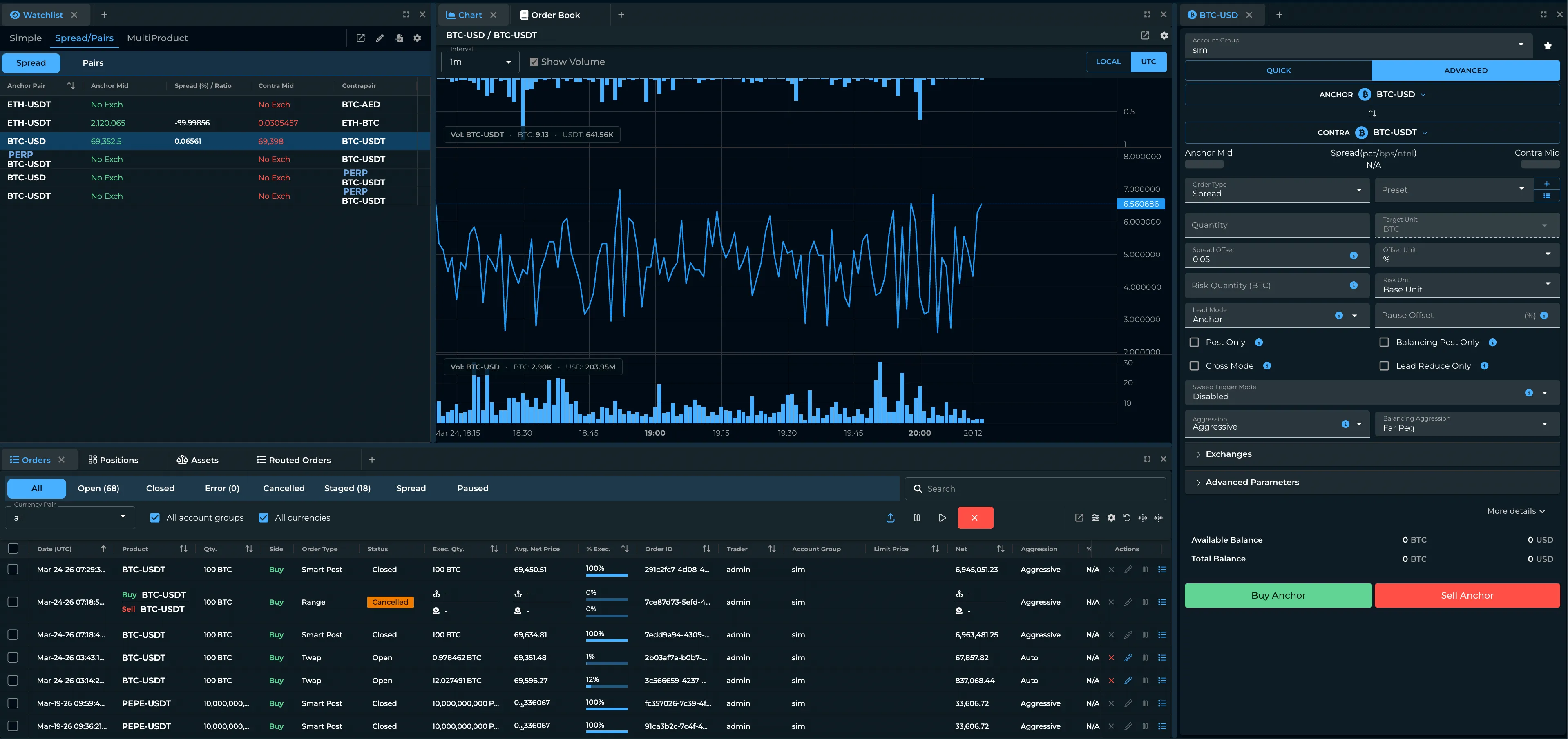
An execution management system is where trading actually happens. It provides consolidated market data, smart order routing, execution algorithms, and direct multi-venue connectivity. Where the OMS cares about what to trade and for whom, the EMS cares about how to trade it well — minimizing slippage and market impact, and capturing the best available price. (See the dedicated article on what a crypto EMS is.)
OEMS: one system for both
An order and execution management system merges OMS and EMS functions so that a single platform handles allocation, compliance, routing, and execution without passing orders between separate systems. The appeal is a unified workflow and one audit trail; the tradeoff is that combined systems sometimes specialize less deeply in one area than a best-of-breed standalone would.
How they fit together
A typical institutional flow runs top to bottom:
The PMS frames a target position based on strategy.
The OMS turns that into a compliant, allocated order.
The EMS executes it across venues using SOR and algorithms.
Fills flow back up to update the OMS records and the PMS positions.
An OEMS collapses steps 2 and 3 into one system.
What's different in crypto
Crypto adds wrinkles that traditional systems were not built for: liquidity is fragmented across dozens of venues with no consolidated tape, settlement and custody models vary widely, markets trade 24/7, and instruments span spot, perpetuals, and DeFi. This raises the bar for the execution layer in particular, an EMS must consolidate fragmented liquidity and route fee-aware in real time, which is exactly the problem smart order routing solves.
Which do you need?
Trading is your bottleneck (slippage, venue access, execution quality)? Prioritize a strong EMS.
Compliance, allocations, and recordkeeping dominate? You need robust OMS capabilities.
You want one workflow end to end? Consider an OEMS.
You manage strategy and exposure decisions? A PMS anchors that, feeding the systems below it.
Most institutions run a combination, integrated via API.
How CoinRoutes fits
CoinRoutes focuses on the execution layer, delivering smart order routing, a full algorithm suite, consolidated market data, and broad venue connectivity, with strategy-based accounts and pre-trade risk controls. Its REST, WebSocket, and FIX interfaces let it integrate with the OMS and PMS systems institutions already run, slotting in as the execution engine of the stack.
Frequently asked questions
What is the difference between an OMS and an EMS? An OMS manages the order lifecycle, allocations, and compliance, the "what and for whom." An EMS executes orders in the market with routing and algorithms, the "how." An OEMS combines both.
Is an OEMS better than separate OMS and EMS systems? It depends. An OEMS offers a unified workflow and single audit trail, while best-of-breed standalone systems often go deeper in their specialty. Many firms weigh integration simplicity against execution depth.
Does a PMS execute trades? No. A PMS tracks holdings and performance and frames investment decisions, but order execution happens in the EMS (or OEMS).
Why do these categories blur in crypto? Because crypto's fragmented, 24/7, multi-custody markets push more intelligence into the execution layer, and many platforms bundle functions rather than splitting them as cleanly as traditional finance does.
Need a crypto execution engine that integrates with your existing OMS and PMS? Book a demo to see how CoinRoutes fits your stack.
Related reading: What Is a Crypto Execution Management System (EMS)? · What Is Portfolio and Risk Management Software for Digital Assets? · What Is Smart Order Routing (SOR) in Crypto?
Request a demo
Find out how CoinRoutes can simplify the way you interact with digital asset markets.