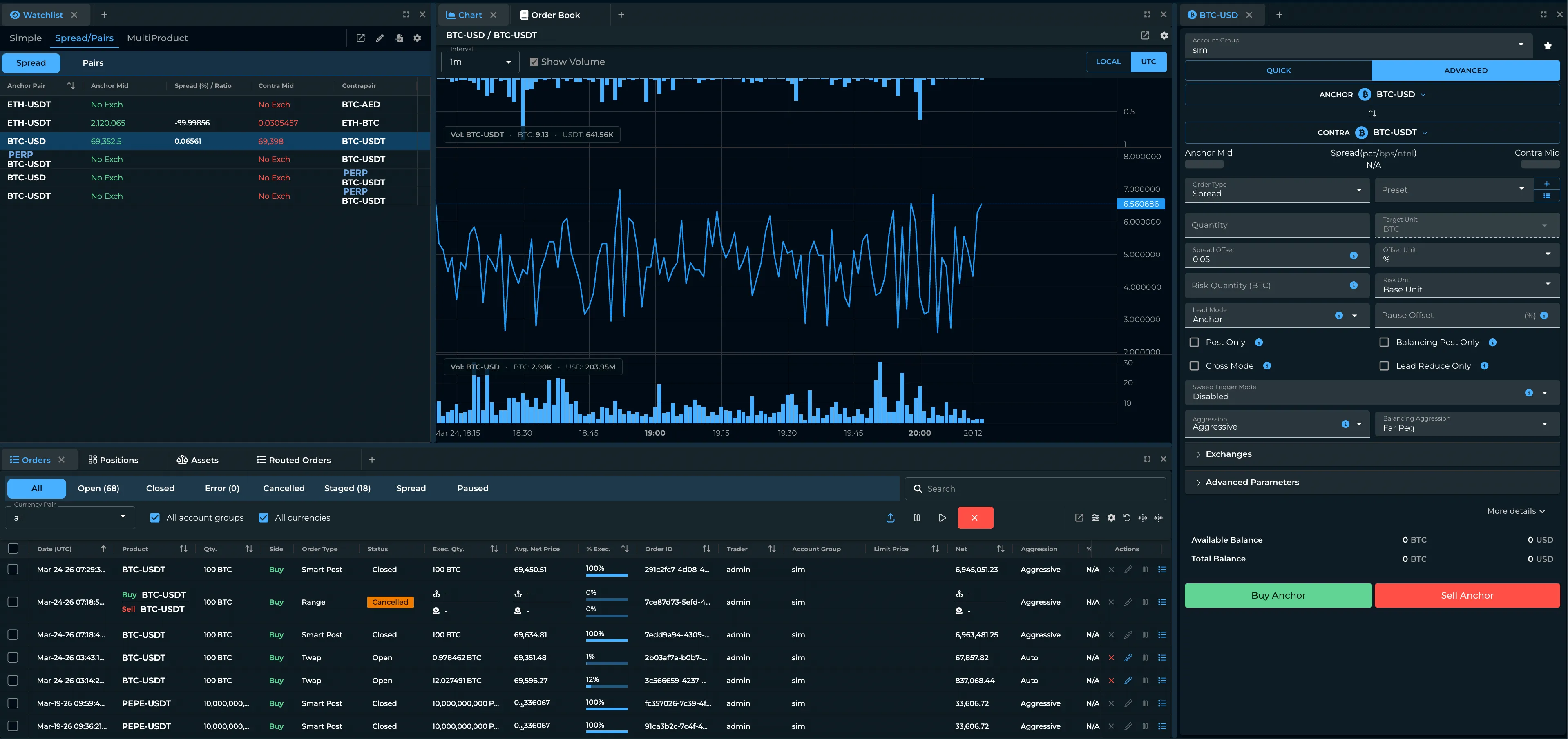
A TWAP paces an order against the clock, forcing the trader to decide how much to trade per minute; a Percent-of-Volume (POV) algorithm paces against the market itself, sizing each clip as a share of live traded volume. Because crypto volume is uneven — it surges around the US open, news, and funding resets, and goes quiet overnight — pacing to volume rather than to time usually means less slippage and market impact, or the freedom to participate faster when liquidity is genuinely there.
The core difference
Both algorithms break a large parent order into smaller child orders to limit impact. What differs is the variable that drives the pace:
- TWAP divides the order evenly across a fixed time window. You implicitly commit to a per-minute rate, regardless of whether the market can absorb it.
- POV targets a participation rate — say, 10% of volume — and tracks observed market volume over each interval, sizing clips up when the market is active and down when it slows.
A TWAP assumes a flat volume profile. Real assets do not trade that way.
Why volume profiles break a fixed schedule
Crypto markets run 24/7 with no official session, and liquidity is highly time-dependent: heavy around major regional opens, macro prints, and large flows; thin in the small hours and on weekends. A TWAP that releases equal size every minute will:
- trade too much during quiet periods, pushing the market and paying slippage because its fixed clip is large relative to available depth; and
- trade too little during active periods, leaving easy liquidity on the table when impact would have been cheapest.
POV inverts both problems. When volume is high, it trades more — capturing cheap liquidity and allowing a higher absolute participation rate. When volume dries up, it pulls back, avoiding the impact of pushing size into a thin book.
TWAP vs. POV at a glance
| Dimension | TWAP | POV |
|---|---|---|
| Paces against | The clock | Live traded volume |
| Trader decides | How much per minute (and end-time) | Target % of volume |
| Behavior in quiet markets | Keeps trading fixed size (impact risk) | Slows down automatically |
| Behavior in active markets | Capped by the schedule | Speeds up to match liquidity |
| Completion time | Fixed | Variable (depends on volume) |
| Typical result | Predictable timing | Lower impact / higher safe participation |
How POV behaves in practice
A POV algorithm continuously measures market volume over short intervals and submits child orders sized to hold the target participation rate. To avoid falling behind when passive fills are slow, it includes catch-up logic toward the end of each interval so the participation target is still met.
CoinRoutes' POV can also run with automatic aggression: it starts passive early in an interval — minimizing impact — and progressively escalates (neutral → aggressive → far peg) only if it nears the interval's end without hitting the target. That gives you low impact when liquidity cooperates and completion when it doesn't, without manual babysitting. As with all CoinRoutes algos, each clip is routed across the consolidated order book for the best net price.
When to use which
Reach for POV when:
- the asset has an uneven or unpredictable volume profile;
- you want to control your footprint relative to the market rather than the clock;
- you can tolerate a variable completion time;
- minimizing market impact is the priority.
Reach for TWAP when:
- you have a hard deadline and need predictable timing;
- the asset is liquid enough that a fixed per-minute rate won't move it;
- you specifically want even, time-distributed exposure (e.g., a scheduled treasury roll).
For thin or illiquid names where forced catch-up is the real risk, also consider Scheduled Post, which paces passively without an IOC catch-up — covered in the companion article.
Markets are dynamic and the right settings depend on real-time conditions. Algorithms support execution but do not guarantee outcomes. This article describes what the algorithm does and when to use it, not its proprietary internals.
Frequently asked questions
What is the main advantage of POV over TWAP? POV sizes each clip to live market volume instead of the clock, so it trades more when liquidity is plentiful and less when it is thin — generally reducing slippage and market impact, or allowing a higher safe participation rate.
Does POV have a fixed end time? No. Because it paces against volume, completion time is variable: if the market is quiet, the order takes longer to finish.
What is a participation rate? It is your target share of market volume — for example, "be 10% of volume." The algorithm throttles clip sizes to stay at or below that share over each interval.
Can POV still finish on time if volume is low? It uses catch-up logic toward the end of each interval, and optional automatic aggression, to meet the participation target even when passive fills fall short — but it will not manufacture liquidity that isn't there.
Want to pace your orders to the market instead of the clock? Book a demo to see POV on your flow.
Related reading: Why CoinRoutes' TWAP Outperforms a Basic TWAP · Crypto Execution Algorithms Explained · Scheduled Post vs TWAP · What Is Market Impact? · What Is Slippage?

Request a demo
Find out how CoinRoutes can simplify the way you interact with digital asset markets.