What Is Slippage, and How Do Execution Algorithms Reduce It?
CoinRoutes
Slippage is the difference between the price you expected when you decided to trade and the price you actually got when the order filled. If you intend to buy BTC at $60,000 but your order fills at an average of $60,090, you experienced $90 of slippage. In fragmented, fast-moving crypto markets, slippage is one of the largest hidden costs of trading — and a primary reason institutions use execution algorithms.
What causes slippage
Slippage comes from a few sources that often act together:
Thin liquidity. If the order book at your target price is too small to fill your whole order, the rest fills at worse prices as you "walk the book."
Market movement. Prices move between the moment you decide and the moment you fill, especially in volatile conditions.
Spread. Crossing the bid-ask spread to execute immediately costs the half-spread on each fill.
Your own footprint. A large order consumes available liquidity and pushes the price against you — this overlaps with market impact.
The larger the order relative to available liquidity, and the more urgently it must fill, the more slippage tends to occur.
Slippage vs. market impact
These terms are related but distinct. Slippage is the measured outcome — the total gap between expected and realized price. Market impact is one cause of slippage: the portion attributable to your own order moving the market. Slippage also includes general price drift and spread costs that would have happened regardless of your order. (See the companion article on market impact.)
How execution algorithms reduce slippage
Execution algorithms reduce slippage by controlling when, where, and how fast an order trades, instead of dumping it into the market all at once. The core techniques:
1. Spreading the order over time. Rather than executing immediately, time-based algorithms break a large parent order into smaller child orders released gradually, so each slice meets fresh liquidity instead of exhausting the book at once.
2. Participating with volume. Volume-based algorithms tie execution to actual market activity, trading more when liquidity is plentiful and less when it is thin — keeping the order's footprint proportional to the market.
3. Posting passively. Posting liquidity (acting as a maker) rather than crossing the spread can capture the spread instead of paying it, and often earns better fees, at the cost of slower, less certain fills.
4. Routing intelligently. Smart order routing sources liquidity across many venues at once, so a slice fills against the deepest available book rather than slipping down a single thin one.
Matching the algorithm to the goal
Algorithm type | How it reduces slippage | Tradeoff |
|---|---|---|
TWAP (time-weighted) | Spreads execution evenly over a window | May lag if volume is uneven |
POV (percentage of volume) | Scales participation to live volume | Pace depends on market activity |
Passive posting | Captures spread, lowers fees | Slower, less certain fills |
Sweep / aggressive | Captures liquidity fast across venues | Prioritizes certainty over price |
The right choice depends on urgency. An order that must fill now will accept more slippage for certainty; an order that can work patiently can minimize slippage by posting and waiting.
How CoinRoutes helps reduce slippage
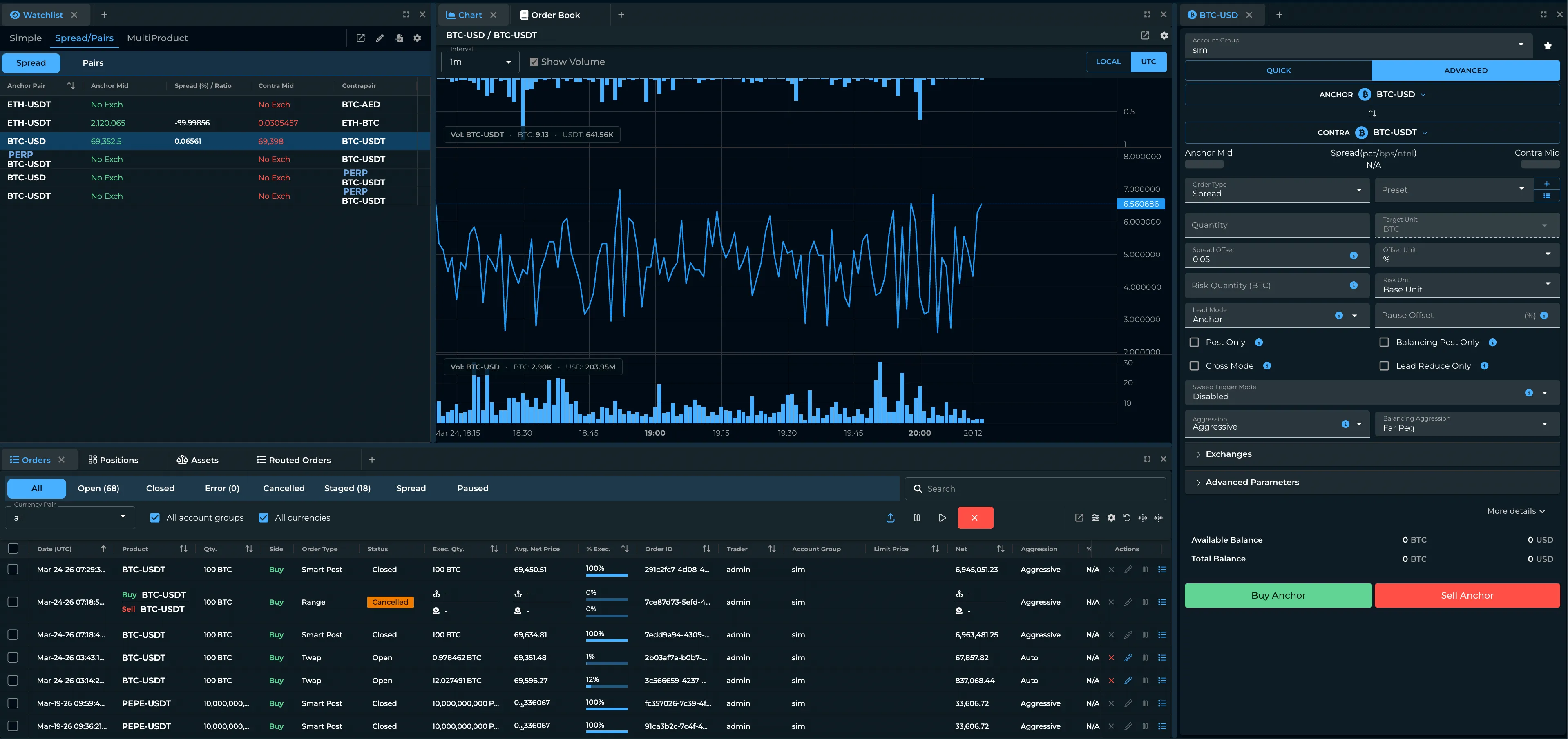
CoinRoutes attacks slippage on two fronts. First, its smart order routing fills each slice against a consolidated, fee-adjusted order book spanning many venues, so orders meet the deepest available liquidity rather than walking a single thin book. Second, its execution algorithm suite — including time-weighted, volume-participation, and passive-posting strategies, with adjustable aggression levels — lets traders calibrate the balance between speed and price for each order. Execution-quality measurement then shows how much slippage occurred against benchmarks like arrival price.
Markets are dynamic, and execution outcomes vary with real-time liquidity and volatility. Algorithms are tools to support execution, not guarantees of a specific result.
Frequently asked questions
What is slippage in simple terms? It is the difference between the price you expected and the price you actually paid or received when your trade executed.
Is slippage always bad? Slippage can be negative (worse than expected) or positive (better than expected). Traders aim to minimize negative slippage, which is the common case for urgent or large orders.
How is slippage different from market impact? Slippage is the total expected-vs-realized price gap. Market impact is the part of that gap caused specifically by your own order moving the price.
Which algorithm minimizes slippage the most? Passive, patient strategies that post liquidity over time tend to minimize slippage, but they trade more slowly and with less certainty. The best choice depends on how urgently the order must fill.
Want to see how much slippage your flow is really paying? Book a demo to explore CoinRoutes' algorithms and execution analytics.
Related reading: What Is Market Impact, and How Do Institutions Minimize It? · Crypto Execution Algorithms Explained · What Is Transaction Cost Analysis (TCA) for Digital Assets?

Request a demo
Find out how CoinRoutes can simplify the way you interact with digital asset markets.