What Is Implementation Shortfall? Formula & Example
CoinRoutes Research Team
Company
What Is Implementation Shortfall? Definition, Formula and Example
CoinRoutes Research Team | November 25, 2026 | 7 min read
This guide explains implementation shortfall, the most complete way to measure trading costs. It covers its four parts, shows how to calculate it with a worked example, and explains how it applies to crypto trading.
DEFINITION: Implementation shortfall is the difference between the paper return of an investment decision and the actual return after all trading costs.
Implementation shortfall is the difference between the return a trade would have made on paper and the return it actually made once real-world costs are included. It answers a simple question every portfolio manager asks: how much did it cost to turn my investment idea into a real position?
The idea was set out by André Perold in 1988 and is now the standard way institutions measure the full cost of trading. It is more complete than measuring fees or slippage alone, because it also counts the cost of waiting and the cost of trades that never happen.
Why implementation shortfall matters
01 - Rule of thumb: the paper portfolio never pays spread, impact or fees. The real one always does.
Imagine a portfolio manager decides to buy bitcoin at 10:00 because the price is $60,000. On paper, that position starts at $60,000. In reality, the order reaches the desk a few minutes later, the price has moved, the order takes time to fill, it pushes the price up as it trades, fees are charged, and part of the order may never fill at all. Each of these steps eats into the return.
Implementation shortfall adds all of these costs together and compares them with the price at the moment of decision. That makes it a fair measure of the whole trading process, not just the trader's last click.
The four parts of implementation shortfall
02 - Framework: delay, execution, fees and opportunity cost. Every basis point belongs to one of them.
1. Delay cost
The price move between the investment decision and the moment the order starts trading (the arrival price). It is caused by slow hand-offs, approvals or waiting for the right time.
2. Execution cost
The difference between the arrival price and the average price actually paid. It includes the spread and the market impact of the order itself. In thin crypto order books, market impact is often the largest piece. See What Is Market Impact?.
3. Fees
Exchange fees, broker commissions and any other explicit charges. These are the only costs that appear on a statement, which is why they are often overestimated in importance.
4. Opportunity cost
The cost of the part of the order that was never filled. If you wanted 100 BTC, bought only 90, and the price kept rising, the missing 10 BTC is a real loss compared with the paper portfolio.
How to calculate implementation shortfall
03 - Worked example: a 100 BTC buy order, step by step.
For a buy order, the basic formula is:
Implementation shortfall = Delay cost + Execution cost + Fees + Opportunity cost |
Let's use simple numbers. A portfolio manager decides to buy 100 BTC when the price is $60,000 (the decision price). The order starts trading when the price is $60,060 (the arrival price). The desk fills 90 BTC at an average price of $60,150. The remaining 10 BTC is cancelled when the price reaches $60,400. Fees are $5,000.
Component | Calculation | Cost |
|---|---|---|
Delay cost | (60,060 - 60,000) × 90 BTC | $5,400 |
Execution cost | (60,150 - 60,060) × 90 BTC | $8,100 |
Fees | Exchange and broker fees | $5,000 |
Opportunity cost | (60,400 - 60,000) × 10 BTC unfilled | $4,000 |
Total shortfall | Sum of the four parts | $22,500 |
The paper value of the order was 100 × $60,000 = $6 million. So the implementation shortfall is $22,500 ÷ $6,000,000 = 37.5 basis points. Breaking it down shows where to improve: here, execution cost is the biggest part, so a better algorithm or routing would help most, while faster hand-offs would cut the delay cost.
Implementation shortfall as an algorithm
04 - In practice: an IS algorithm balances the cost of trading fast against the risk of trading slowly.
The term also describes a type of execution algorithm, sometimes called an arrival price algorithm. Its goal is to keep the final price as close as possible to the arrival price. Trading fast reduces the risk that the price drifts away, but increases market impact. Trading slowly reduces impact, but leaves the order exposed to price moves for longer. An implementation shortfall algorithm finds a balance, usually trading more at the start and slowing down as the order progresses.
In crypto, this trade-off is sharper than in most markets. Volatility is high, so waiting is risky, but order books are thinner, so trading fast is expensive. That is why measuring shortfall after every order is so useful: it shows whether a desk is leaning too far one way. For a comparison with other algorithms, see Crypto Execution Algorithms Explained.
How CoinRoutes fits
IN PRACTICE - CoinRoutes: execution tools that cut each part of the shortfall, and TCA that measures it.
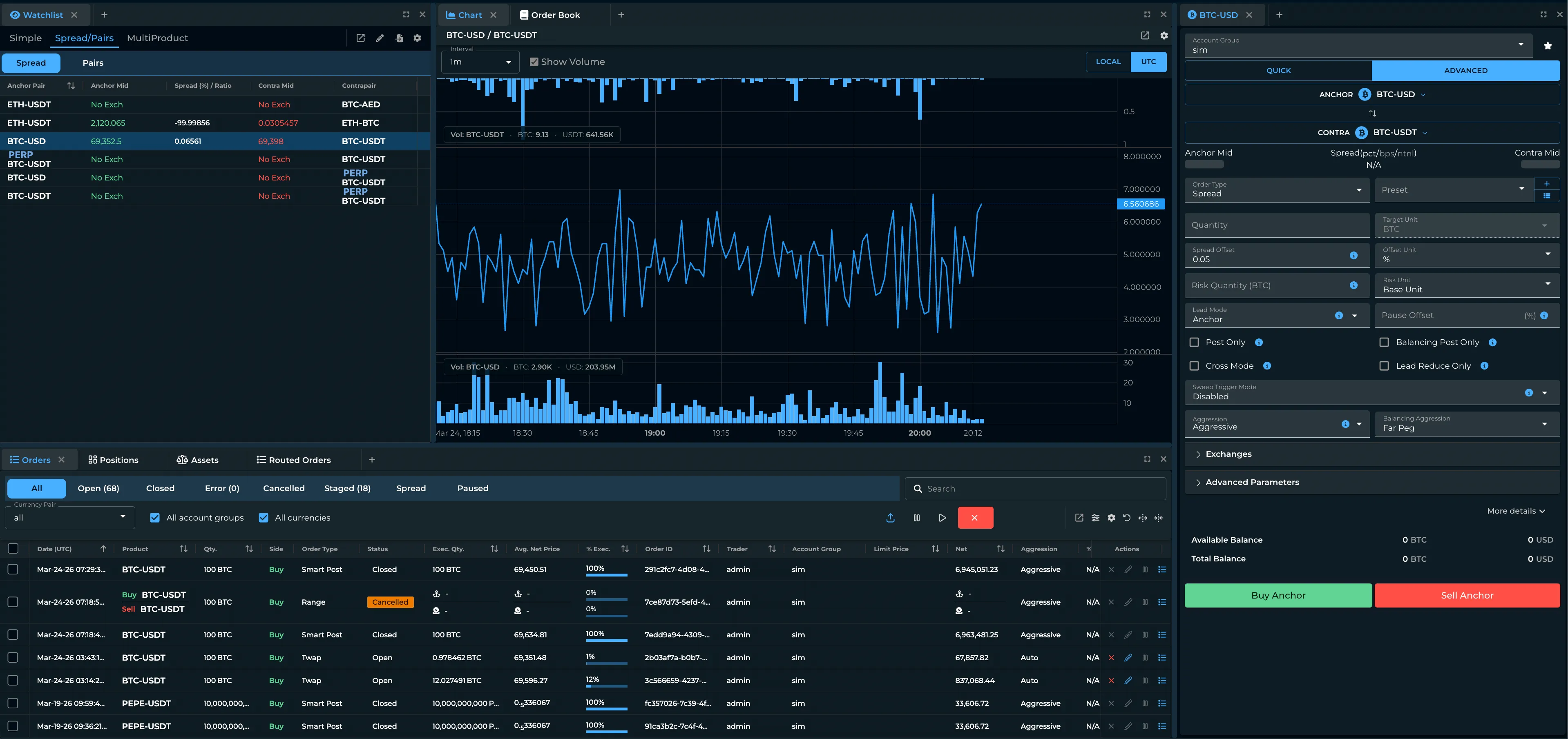
CoinRoutes is built to reduce each part of implementation shortfall. Orders move straight from portfolio decision to execution in one platform, which reduces delay. Patented smart order routing across a consolidated order book of more than sixty venues, together with algorithms such as Smart Post, TWAP and POV, reduces spread and market impact. Smart Post works orders passively where possible, which lowers fees by mainly paying maker rates.
Built-in transaction cost analysis then measures every order against arrival price and other benchmarks, so traders and portfolio managers can see exactly where each basis point went. Read more in What Is TCA for Digital Assets? and Slippage, and How Execution Algorithms Reduce It.
Frequently asked questions
What is implementation shortfall in simple terms?
It is the total cost of turning an investment decision into a real trade: the gap between the paper return at the decision price and the actual return after delays, market impact, fees and unfilled orders.
How do you calculate implementation shortfall?
Add the delay cost, the execution cost, the fees and the opportunity cost of any unfilled shares, then divide by the paper value of the order to express it in basis points.
What is the difference between implementation shortfall and slippage?
Slippage usually measures only the gap between the expected price and the fill price. Implementation shortfall also includes delay, fees and the cost of the part of the order that was never filled.
Who created implementation shortfall?
André Perold introduced it in a 1988 paper in the Journal of Portfolio Management.
What is an implementation shortfall algorithm?
It is an execution algorithm that aims to keep the average fill price close to the arrival price by balancing market impact against the risk of the price moving while the order works.
Exhibits and examples are illustrative and do not quote market data. Product features described are as of the publication date. This note is for informational purposes only and is not investment advice.

Request a demo
Find out how CoinRoutes can simplify the way you interact with digital asset markets.