EXCHANGE BASED RWAs VS TRADITIONAL ASSETS. A single equity like Nvidia now trades on Nasdaq and, at the same time, onchain as an exchange based real world asset. The two prices rarely match to the tick, and for institutions that gap is the opportunity: cross venue basis and perpetual funding, captured across one execution stack.
01 Two versions of the same stock
On Nasdaq, Nvidia is a registered share. It trades during a fixed session, settles the following business day, and carries dividends and voting rights. Onchain, the same price exposure appears in more than one form. Tokenized spot equity is backed one for one by shares held in a special purpose vehicle, so the holder has real economic exposure without holding the share directly; the xStocks and Ondo product families are examples. Perpetual futures are different again: cash settled contracts that track the equity by oracle price, with no shares, dividends, or voting attached, listed on venues such as Hyperliquid where independent builders can deploy new perpetual markets on a shared order book. In wrapper terms these are digital assets and tokenized assets; in economic terms they are equities, and they trade around the clock.
02 Why the two prices diverge
The listing and its onchain counterparts reference the same company, but they are separate instruments sitting on fragmented, disconnected pools of liquidity, so they seldom line up exactly. Two forces open the gap. Hours: Nasdaq runs a fixed session while onchain markets trade continuously, so overnight and weekend news moves the onchain mark while the cash market is frozen, and the listing gaps toward it at the next open. Funding: a perpetual has no expiry to force convergence, so a periodic funding payment does the work instead. When the perpetual is rich to its reference, longs pay shorts; when it is cheap, shorts pay longs. Funding is therefore both a tether and a price, the cost or the yield of carrying the onchain leg.
03 The two trades: basis and funding carry
For a desk that can reach both markets, the divergence supports two familiar relative value trades, shown in Exhibit 1. A cross venue basis trade buys the cheaper venue and sells the richer one and holds for convergence. A funding carry trade is run market neutral: hold tokenized spot equity for the exposure and short the matching perpetual, so the book is hedged on price while it collects funding as yield, with the legs reversed when funding turns negative. Both are a form of cross asset trading on the same underlying, the province of hedge funds, proprietary trading firms, asset managers, and other institutional investors running quantitative and discretionary books across global markets.

04 Executing both sides
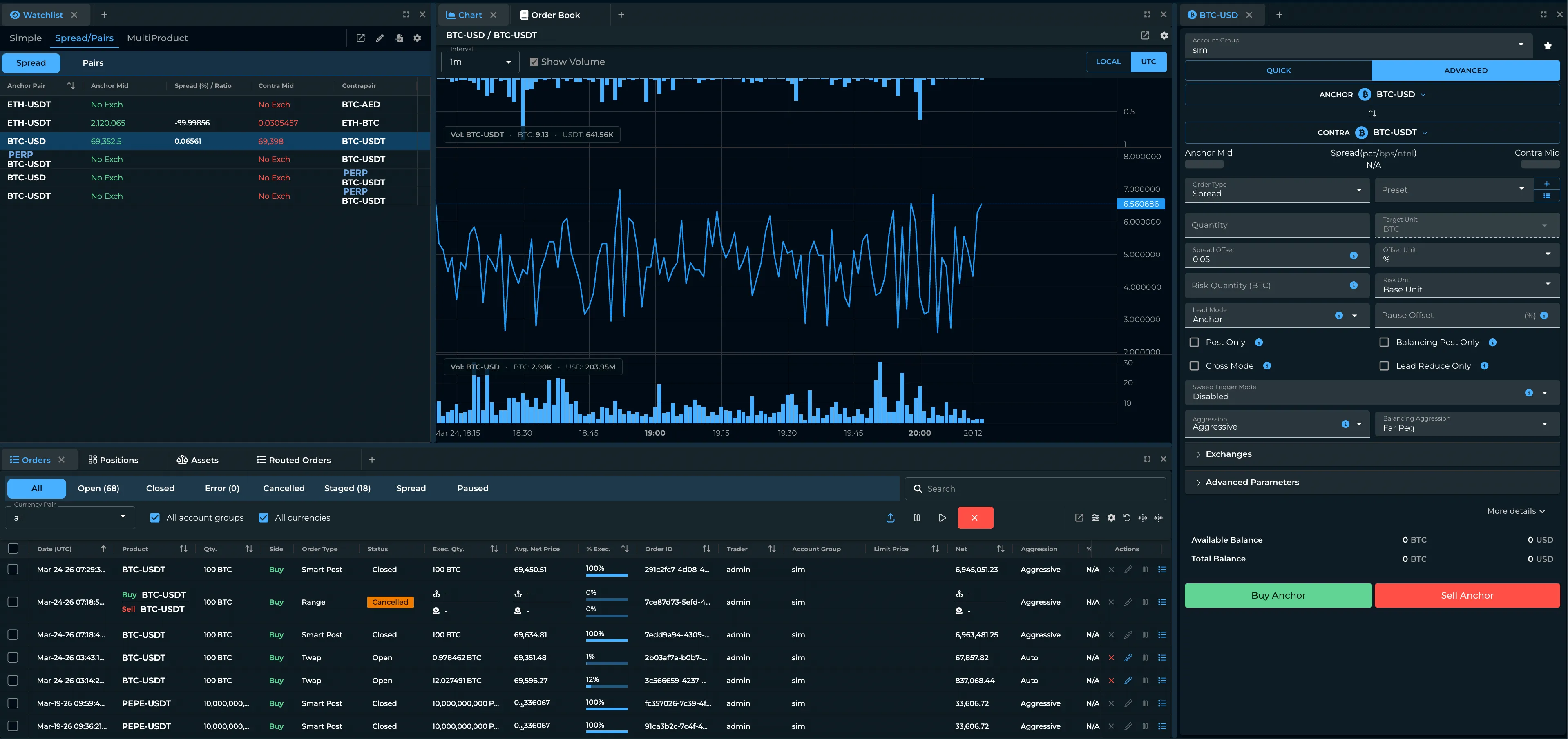
The idea is standard; the reach is the hard part. Capturing basis and funding means quoting and filling two legs at once, in different market structures, without letting fragmentation erode the edge. CoinRoutes is an institutional, multi asset trading platform built for exactly this: liquidity aggregation across 60+ CeFi, DeFi, and liquidity provider venues into one fee adjusted view, with smart order routing that seeks best execution on each leg. Its multi asset algorithmic trading suite, including a flagship Spread strategy, is designed to trade tokenized equities, traditional equities, equity perpetual futures, and traditional futures in a single workflow, and its integration with tokenized equity issuers such as xStocks brings that inventory into the same book. Portfolio management, position management, real time risk management, and transaction cost analysis for post trade performance analytics all sit within a single order and execution management system (OEMS), so the basis and the funding are monitored, executed, and measured in one place rather than stitched across venues. The same pattern is now emerging beyond equities, in tokenized commodities and other real world assets.
WHY IT MATTERS
Tokenization is turning one company into several tradable instruments at once. The relationships between them, not any single venue, are where the relative value sits.
KEY TERMS
Real world asset (RWA): An offchain asset such as an equity or commodity, represented onchain as a token.
Tokenized spot equity: A token backed one for one by real shares held by a custodian or special purpose vehicle. Economic exposure, not the share itself.
Perpetual future: A derivative with no expiry, held toward its reference price by a recurring funding payment.
Funding rate: The recurring payment between longs and shorts that anchors a perpetual to its reference. It is a cost to one side and a yield to the other.
Basis: The price difference between two instruments on the same underlying.
This note is general information about market structure and is not investment, legal, or tax advice. It describes how instruments and venues relate, not a recommendation to trade any of them. Instrument availability varies by venue and jurisdiction.
Request a demo
Find out how CoinRoutes can simplify the way you interact with digital asset markets.