CeFi vs. DeFi: Two Markets, One Order
CoinRoutes Research Team
Company
A look at how centralized and decentralized venues differ, the tradeoffs of each, and how one platform can access both.
For most of crypto's history, "where you trade" was a simple question. Liquidity lived on a handful of centralized exchanges, and that was that. It isn't anymore. Today the best price for the same asset can sit on a centralized order book one minute and an onchain perpetual the next, and the two do not always agree. For institutional traders, that fragmentation is the core challenge. Centralized finance (CeFi) and decentralized finance (DeFi) each solve different problems and carry different risks. Accessing them as a single market, rather than as rival camps, is increasingly what best execution requires.
The difference in one line: CeFi runs on trusted intermediaries, the exchanges and OTC desks that hold your assets and match your orders. DeFi runs on code, the onchain venues where you keep custody and the protocol settles the trade. Almost everything else follows from that distinction.
CeFi: deep liquidity, with a custody question
Centralized venues are where institutional crypto grew up, and it shows. They concentrate the deepest books and tightest spreads on major pairs, run fast matching engines, and offer the full derivatives stack alongside spot. Around the trade itself sits real operational maturity: established credit, settlement, fiat ramps, and custody integrations.
The risks are the flip side of that convenience. In CeFi, your assets and collateral typically sit with the venue, which concentrates counterparty and custody risk, a lesson the market has relearned painfully. Liquidity is also split across dozens of exchanges, each with its own API, fee schedule, and margin rules, so the best price is rarely on any single book.

DeFi: custody stays yours, with onchain costs
On the decentralized side, the standout for institutions is the perpetual DEX. Venues like Aster, Hyperliquid, and Lighter now offer serious onchain depth in perpetuals without asking you to hand over your keys. Settlement is transparent and onchain, access is permissionless, and counterparty risk drops because custody never leaves your control.
The risks are different in kind rather than degree. Onchain trading introduces funding and network costs, latency bound by block times, and mechanics (slippage, MEV, smart contract and oracle risk) that simply do not exist in CeFi. None of it is disqualifying. All of it has to be actively managed.

Advantages and risks at a glance

Why it matters: the liquidity is split
Here is the catch that ties it all together. Because CeFi and DeFi price liquidity differently, the same asset can trade at two prices at the same moment. For best execution, that gap is both a risk to manage and, if you can see and reach both sides at once, an opportunity to capture. Reaching both reliably and at scale is a real engineering problem: dozens of centralized APIs, onchain connectivity, one consolidated view of price, and unified risk and reporting across two very different settlement models.
How CoinRoutes accesses both
This is the gap CoinRoutes is designed to close. Solving it starts with liquidity aggregation: pulling 60+ CeFi, DeFi, and liquidity provider venues into one consolidated view, then sourcing a single order across them. A few things make that work at institutional scale.
Orders route against a consolidated best bid and offer. This smart order routing sends each child order to a venue only when its price is genuinely best, net of fees, whether a centralized book or an onchain pool. API keys stay on the client's own infrastructure, so you diversify across venues without surrendering custody. Order randomization keeps large orders undiscoverable, and integrated transaction cost analysis measures every fill, CeFi or DeFi, on one comparable basis.
The advantage of one tool for both
A single tool that reaches both worlds changes the execution calculus. It reduces the chance of missing a better price that happened to be on the venue you were not watching. It spreads counterparty risk across many venues instead of concentrating it in one. And it makes it possible to trade the relationship between the two markets directly, which is where algorithmic trading comes in.
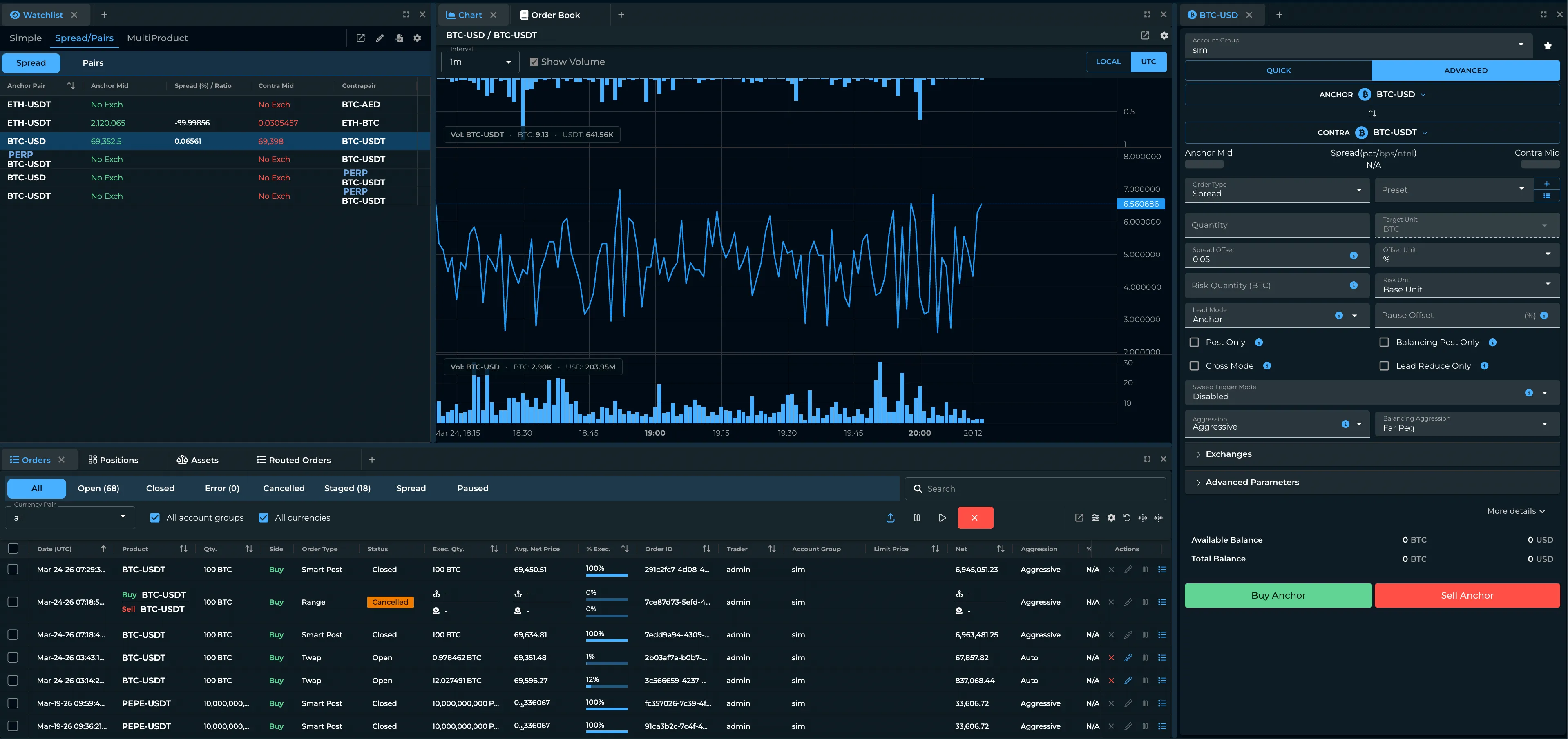
That is what the CoinRoutes Spread algorithm is built for. It works two legs at once, buying on one venue while selling on another, to capture a target spread while net exposure stays controlled. Long spot on a centralized exchange against a short perp on a DeFi DEX becomes a single, market neutral position. It is suited to basis and funding trades, to capturing CeFi and DeFi dislocations, and to treasury and risk management. The gaps between the two markets become something measurable rather than a nuisance.

For institutions, the CeFi versus DeFi question is less a choice than a coordination problem. The liquidity is in both places. The risks of each are different but manageable. Accessing both through a single execution layer is what turns the gap between them from a source of slippage into something a desk can measure and, with the right tools, trade.
Every venue. One platform.
The gap between CeFi and DeFi is a position, not a nuisance. Book a demo with the CoinRoutes team.

Request a demo
Find out how CoinRoutes can simplify the way you interact with digital asset markets.