What is an Order and Execution Management System?
CoinRoutes Research Team
Company
How institutional desks turn investment decisions into executed trades, keep a clean view of risk and positions, and why digital assets raise the bar on what the system has to do.
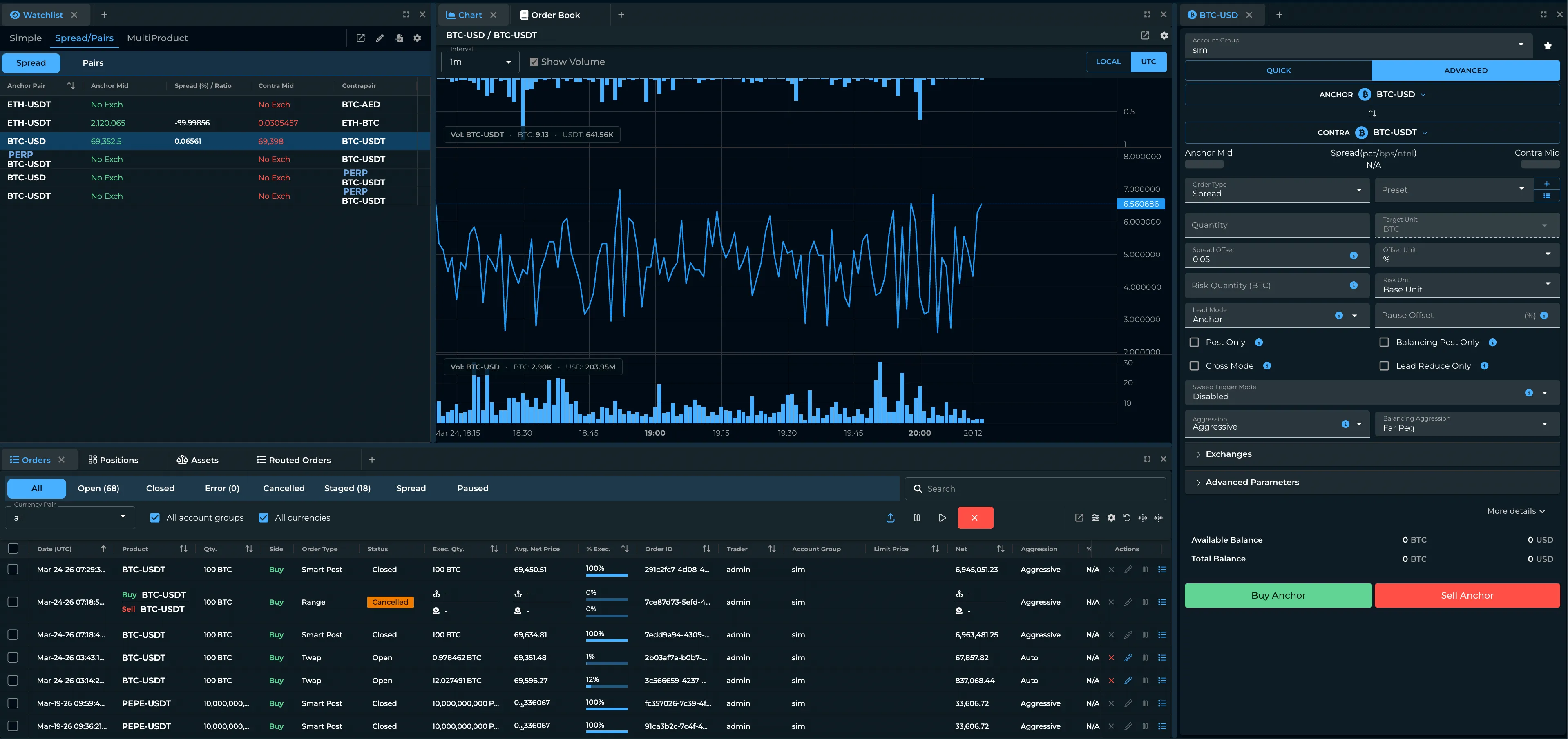
An order and execution management system, usually shortened to OEMS, is the software backbone an institutional trading desk uses to turn an investment decision into an executed trade and then track what happened. It sits between the people deciding what to buy or sell and the venues where those orders actually fill, coordinating everything in between. For years the market handled this in two separate tools. The OEMS brings them together into one continuous workflow, and in digital assets, where markets never close and liquidity is spread thin across dozens of venues, that single view becomes hard to do without.
01 From two systems to one
The category grew out of two different tools that solved two different problems. An order management system, or OMS, was built around the portfolio. It was the system of record: where orders originated, where compliance rules lived, and where allocations, holdings, and position management were tracked over time. Buy side firms leaned on the OMS as the authoritative book of what they owned.
An execution management system, or EMS, was built around the act of trading. It gave traders fast market access, live market data, and the routing and algorithmic trading tools needed to work an order into the market with care. Quantitative trading teams and active desks lived inside the EMS because that is where speed and control sat.
The trouble was the seam between them. Passing orders from one system to the other introduced delays, reconciliation work, and room for error, and it meant no single screen told the whole story. The OEMS closes that seam by covering the full path, from the decision to the fill to the updated position, inside one system.

02 What an OEMS actually does
Underneath the label, an OEMS carries a set of jobs that have to work together. Order management captures an order, tracks its status from open to filled, and books the results back to the right accounts. Execution management connects to venues and decides how an order interacts with the market, often through execution algorithms that pace and place child orders rather than firing one large order into thin liquidity.
Alongside those, the system keeps portfolio management and position management current as fills arrive, so the desk always knows its exposure rather than learning it after the fact. Risk management runs in the same loop: limits and exposure checks sit at the point of order entry, catching a problem before an order is released rather than flagging it the next morning. Compliance and reporting capture the audit trail and the evidence a desk needs to show best execution. Tying it together, trading workflow automation moves the routine work, the repetitive routing, splitting, and booking, off the trader's plate so attention goes to the orders that need it.

03 Why digital assets raise the bar
Most of these ideas came from equities and other established markets. Crypto keeps the requirements and then adds several of its own. Markets run continuously, with no opening bell or close, so the system and the controls around it have to operate around the clock rather than within a session. Liquidity is also fragmented to a degree traditional markets rarely see: the same asset trades across many centralized exchanges, a growing set of decentralized venues, and a roster of liquidity providers, each with its own prices and depth at any given moment.
The plumbing differs too. Some venues hold assets in custody and match orders offchain, while others settle onchain against a self custody wallet, and an OEMS has to reach both without making the trader think about the difference. The range of what desks trade keeps widening as well, from spot and derivatives to tokenized assets and exposure that reaches into commodities. Pulling all of that into one consolidated book, with one view of liquidity and one view of risk, is the central job of an OEMS built for this market.

04 Bringing it back to the desk
This is the problem CoinRoutes was built around. The platform provides an order and execution management system for institutional digital asset trading, aggregating liquidity across more than sixty centralized exchanges, decentralized venues, and liquidity providers so a desk sees one consolidated book rather than dozens of disconnected ones. Its smart order routing, the subject of the firm's patent, reads that aggregated liquidity and works to achieve best execution across venues as conditions move.
On top of that routing sits a set of execution approaches a desk can reach for depending on the order in front of it: passive posting through Smart Post, fast liquidity capture through Sweep, scheduled participation through TWAP, and relationship trades through Spread and Pairs, among others. Underneath, the same system keeps a consolidated view of positions and risk across every venue the desk touches, so the picture stays whole even when the liquidity behind it is scattered. That combination is what makes the platform useful to the range of institutions it serves, from hedge funds and asset managers to proprietary trading firms, market makers, family offices, and broker dealers, each of whom needs the same thing in the end: a single, trustworthy place to decide, trade, and account for what they own.
IN SHORT
An OEMS is the operating layer of a modern trading desk. It started as two tools, the portfolio focused OMS and the execution focused EMS, and converged into one because the seam between them was costing desks time, accuracy, and a clear view of risk. Digital assets make that single view harder to assemble and more valuable to have, which is exactly the gap a purpose built crypto OEMS is meant to fill.
Decide, trade, and manage it all in one place. Book a demo with the CoinRoutes team.

Request a demo
Find out how CoinRoutes can simplify the way you interact with digital asset markets.