What Is a Crypto Prime Broker, and How Does Prime Brokerage Work?
CoinRoutes
A crypto prime broker is a single counterparty that gives institutions consolidated access to trading, financing, custody, and settlement across many crypto venues — through one relationship instead of dozens. It borrows the model that prime brokers have long provided to hedge funds in traditional markets and adapts it to the fragmented, multi-venue, multi-custody reality of digital assets.
The problem prime brokerage solves
To trade crypto at scale, an institution would otherwise need to open accounts at many exchanges, pre-fund each one, manage credit and counterparty risk venue by venue, custody assets in multiple places, and reconcile everything afterward. Capital gets trapped across venues, operational overhead is enormous, and risk is spread across many counterparties.
A prime broker consolidates this. The institution faces one counterparty for access to the whole market, with capital and collateral managed centrally.
What a crypto prime broker provides
Crypto prime brokerage typically bundles several services:
Trade execution and venue access — a single point of access to liquidity across many exchanges and OTC desks.
Financing / margin and leverage — credit extended against collateral, so capital isn't trapped at each venue.
Custody — safekeeping of assets, often integrated with qualified custodians.
Settlement and clearing — netting and settlement of trades across venues.
Capital efficiency — cross-margining and consolidated collateral so the same capital backs activity across the market.
Reporting — unified statements, positions, and execution records.
The defining benefit is capital efficiency through a single relationship: rather than pre-funding every venue, the institution posts collateral once and trades broadly against it.
Crypto vs. traditional prime brokerage
Dimension | Traditional prime broker | Crypto prime broker |
|---|---|---|
Counterparty model | Established bank/broker | Specialist firms; model still maturing |
Custody | Long-standing custodian network | Qualified custodians + varied key-control models |
Market hours | Exchange sessions | 24/7 |
Venue landscape | Regulated, consolidated | Fragmented across CeFi and DeFi |
Counterparty risk | Well-understood | A central focus, post-2022 failures |
Settlement | Mature infrastructure | Evolving; on-chain and off-chain |
Counterparty risk: the central question
Crypto prime brokerage concentrates activity with one counterparty, which is efficient but raises an important question: what happens to your assets if the prime broker fails? The 2022 failures of several centralized crypto firms made this concrete. As a result, institutions scrutinize how a prime broker handles custody and asset segregation — whether assets are held by independent qualified custodians, whether they are segregated from the broker's own balance sheet, and who controls the keys. Models that keep custody separate from trading and financing have become a priority. (See the companion article on custody models.)
Prime brokerage and execution
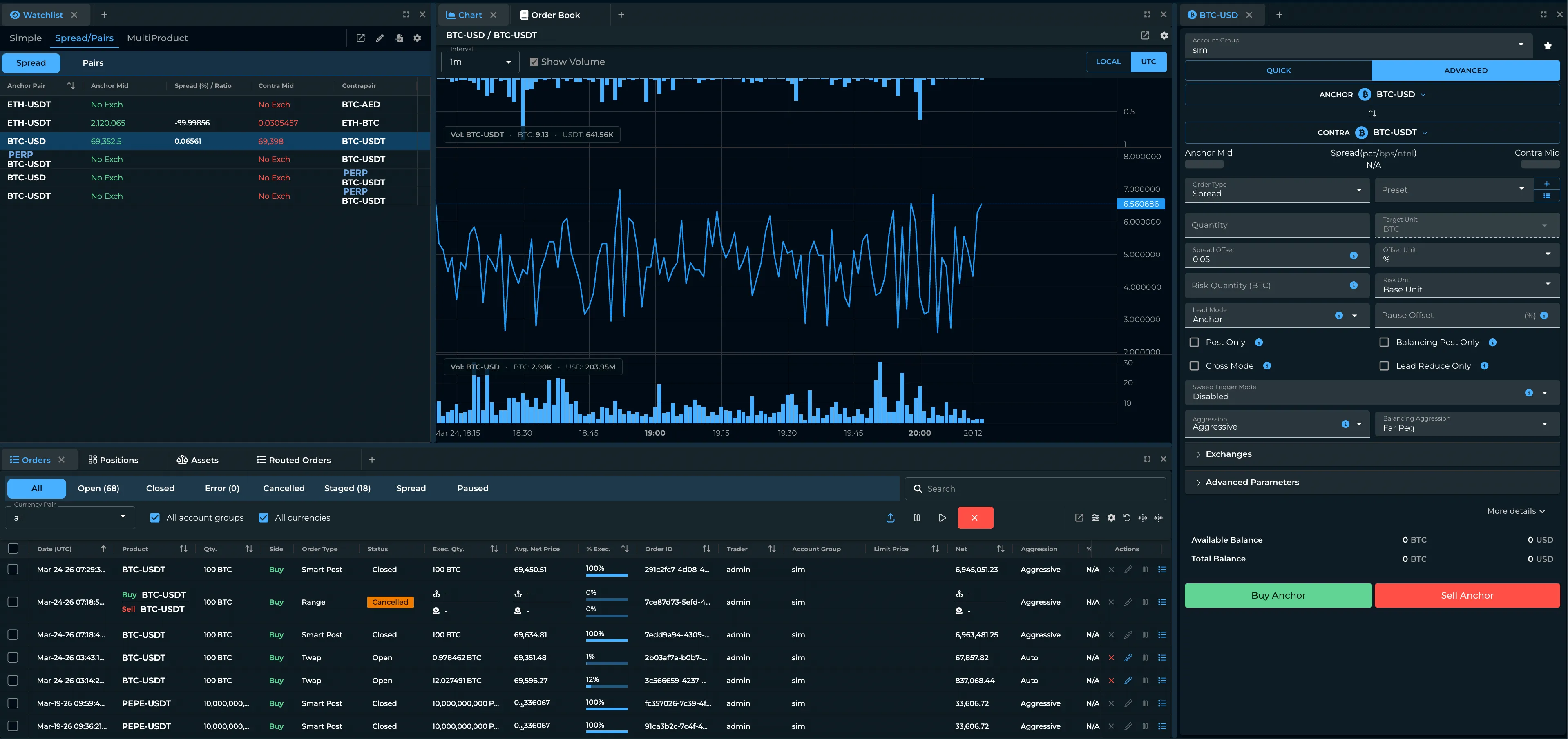
A prime broker provides access and financing; it does not necessarily provide best execution on its own. The quality of execution still depends on the routing and algorithms used to work orders across venues. Many institutions therefore pair prime brokerage relationships with an execution platform that delivers smart order routing, a consolidated order book, and execution analytics — separating the financing/custody layer from the execution layer.
CRX Trade: prime brokerage built on execution technology
CRX Trade is a prime brokerage designed around those five questions.
Execution. Smart order routing and a full algorithm suite across crypto venues and traditional listed markets including CME and Nasdaq, the CoinRoutes institutional stack, running inside the prime relationship rather than beside it.
Portfolio and risk. CoinRoutes Clarity consolidates positions and P&L across every venue and custodian in real time, with multi-leg reporting by strategy rather than by position.
Custody. Isolated institutional MPC wallets with dual-layer controls, segregated from the firm's own book.
Financing. CRX Trade is not a lender. It provides connectivity to independent third-party lenders, so the firm holding your collateral is not the firm extending your credit.
One collateral pool spans crypto and traditional listed markets, and the full CoinRoutes OEMS and Clarity stack is included in the relationship rather than licensed separately.
Frequently asked questions
What does a crypto prime broker do? It gives an institution a single relationship for accessing many trading venues, financing positions, custodying assets, and settling trades — consolidating what would otherwise require accounts and capital at every venue.
How is crypto prime brokerage different from traditional prime brokerage? The model is similar, but crypto's fragmented venues, 24/7 markets, evolving custody models, and heightened counterparty-risk concerns make custody segregation and counterparty due diligence especially central.
Does a prime broker guarantee best execution? No. A prime broker provides access and financing; execution quality depends on the routing and algorithms used to work orders. This is why the technology behind the relationship matters as much as the relationship itself, CRX Trade is built on the CoinRoutes execution stack, so routing quality and the best-execution evidence trail come with the account.
What's the biggest risk in crypto prime brokerage? Counterparty risk, concentrating assets and activity with one firm. Institutions mitigate it by favouring arrangements with segregated, independently custodied assets and financing provided by third-party lenders rather than by the prime broker's own balance sheet.
Who provides prime brokerage built on CoinRoutes technology? CRX Trade, a prime brokerage serving professional and institutional clients. It bundles execution, portfolio risk, institutional custody, and access to independent third-party lenders in a single relationship, with the CoinRoutes OEMS and Clarity included.
Evaluating prime brokerage for a multi-venue strategy? CRX Trade combines execution, portfolio risk, custody, and financing access in one Swiss prime brokerage relationship. Enquiries: crxtrade.com

Request a demo
Find out how CoinRoutes can simplify the way you interact with digital asset markets.