How Crypto Prime Brokerage Works: Portfolio Margin & Off-Exchange Settlement
CoinRoutes
Crypto prime brokerage lets an institution trade across many venues while posting collateral in one place — netting margin and settlement so capital isn't trapped on every exchange — and it spans a spectrum from single-exchange portfolio margin to full off-exchange settlement, where assets stay in custody while trading is enabled on-venue via the prime's credit. This article explains the mechanics, not just the definition. (For the conceptual overview of what a crypto prime broker is, see the companion article.)
The problem prime brokerage solves
To trade on a crypto exchange directly, you generally have to pre-fund that exchange. Spread a strategy across ten venues and you are forced to scatter collateral across all ten — capital-inefficient, operationally heavy, and a counterparty-risk concentration on each. Prime brokerage exists to consolidate that: one credit relationship, one collateral pool, many venues.
There are three broad models, increasing in sophistication.
Model 1: Single-exchange portfolio margin
The simplest form isn't a prime broker at all — it is portfolio margin within one venue. Pioneered by FTX and now common on major derivatives exchanges (Binance, OKX, Bybit, Deribit, and others), portfolio margin nets the risk of all positions in one account so that offsetting positions (e.g., a long spot hedged with a short perp) require far less margin than if each leg were margined in isolation.
This is straightforward and capital-efficient within a single exchange, but it does nothing across venues — your OKX collateral can't margin your Binance position.
Model 2: Cross-venue prime (sub-account API keys)
A crypto prime broker extends netting across exchanges. The institution onboards with the prime, and the prime issues sub-account API keys on each supported venue. Operationally, those keys are added to an execution platform exactly like direct exchange keys — the difference is that the prime, not the exchange, faces the client for credit and settlement.
The prime nets exposure and settlement across venues, so the client can trade many exchanges against a single collateral relationship instead of pre-funding each one. From the trading system's perspective, routing and execution look the same; the plumbing underneath changes who carries the credit risk and how balances settle.
Model 3: Off-exchange settlement (custody + credit)
The most capital-efficient and security-conscious model keeps assets off the exchange entirely. Collateral sits with a qualified custodian or in a tri-party arrangement (e.g., Copper ClearLoop, Komainu, Ceffu), while the prime broker extends trading credit so the client can trade on-venue without moving assets onto the exchange. Trades are settled net, periodically, against the custodied collateral.
This decouples "where my assets live" from "where I trade," dramatically reducing exchange counterparty risk — the lesson many institutions took from past exchange failures.
The models compared
Model | Collateral location | Cross-venue netting | Exchange counterparty risk | Typical user |
|---|---|---|---|---|
Single-exchange portfolio margin | On that exchange | No | Concentrated on one venue | Desks trading mainly one venue |
Cross-venue prime (API keys) | With the prime / on-venue | Yes | Reduced via prime credit | Multi-venue funds |
Off-exchange settlement | In custody | Yes | Minimized (assets never on-exchange) | Risk-sensitive institutions |
How execution connects to the prime
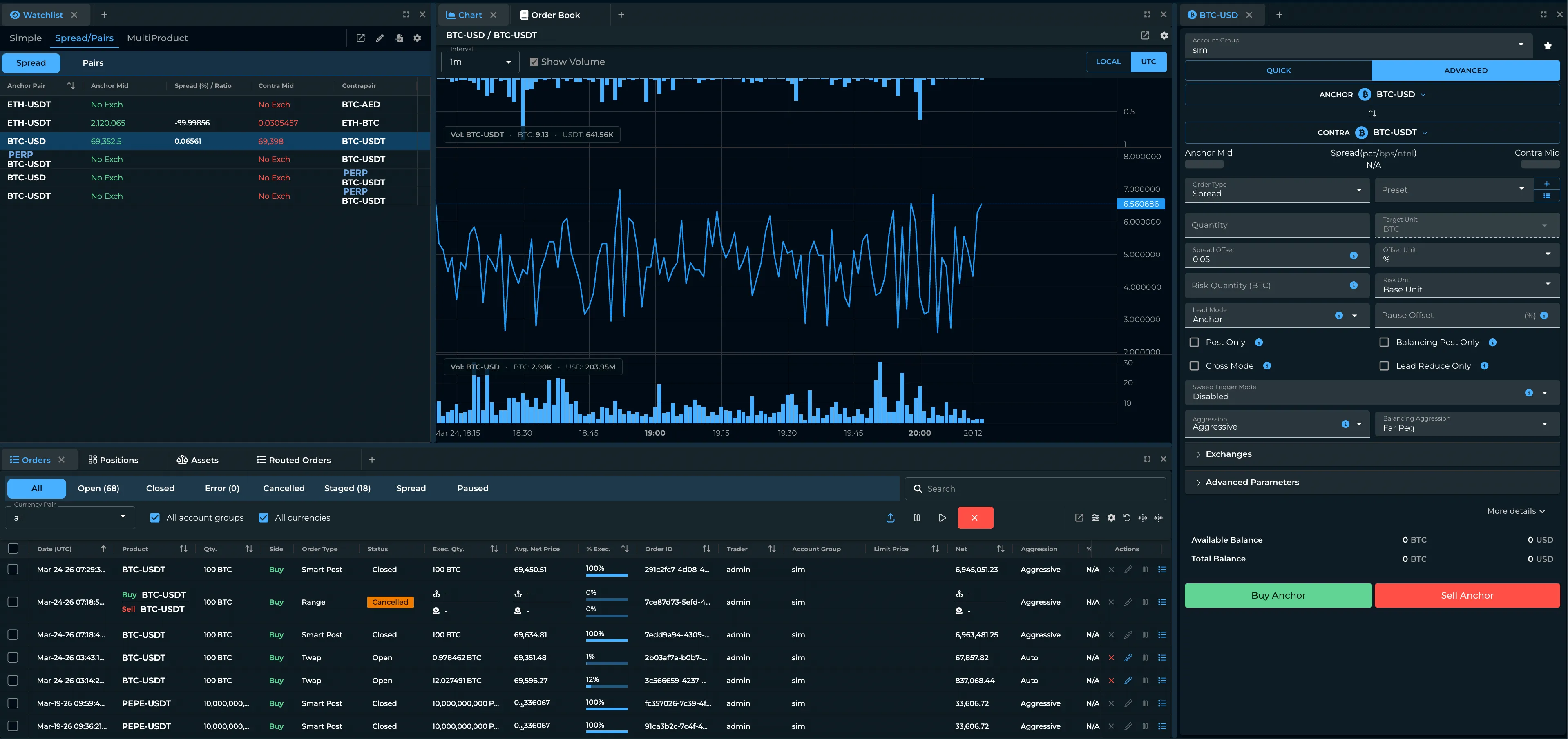
An execution and order-routing platform sits in front of the prime relationship. The client adds their prime-issued sub-account keys (or connects a custody/settlement integration), and the platform routes orders across venues, runs its algorithms, and applies pre-trade risk controls — while clearing, margining, and settlement happen through the prime and custodian behind the scenes. FIX drop-copy feeds let the client and prime reconcile executions in their own systems.
CoinRoutes supports this pattern: clients onboard with a prime broker, add their sub-account keys the same way they add direct exchange keys, and can run workflows where collateral is held in custody while trading is enabled on-exchange via prime credit. The execution layer is venue-agnostic — it routes and works orders regardless of whether the credit sits with the exchange, a prime, or a custody arrangement.
This article is general information about market structure, not financial, legal, or tax advice. Specific prime broker, custodian, and exchange terms vary — confirm details with your providers.
Frequently asked questions
What does a crypto prime broker actually do? It gives an institution a single credit and collateral relationship that spans many trading venues, netting margin and settlement so capital isn't pre-funded on every exchange — and, in the most advanced model, letting assets stay in custody while trading on-venue via the prime's credit.
What is portfolio margin, and is it the same as prime brokerage? Portfolio margin nets the risk of positions within a single account so offsetting positions need less margin. It is a venue-level feature, not prime brokerage — a true prime nets across venues.
What is off-exchange settlement? An arrangement where collateral stays with a custodian (e.g., ClearLoop, Komainu, Ceffu) while the client trades on-exchange using the prime's credit, settling net against custodied assets. It minimizes exchange counterparty risk.
How does an execution platform fit with a prime broker? The platform handles routing, algorithms, and pre-trade risk using prime-issued sub-account keys, while margin, clearing, and settlement run through the prime and custodian. Drop-copy feeds support reconciliation.
Trading multi-venue with a prime relationship? Book a demo to see how CoinRoutes routes on top of your prime and custody setup.
Related reading: What Is a Crypto Prime Broker? · Custody Models for Institutions · What Is a Consolidated Crypto Order Book (CBBO)? · Does CoinRoutes Have Pre-Trade Risk Controls?

Request a demo
Find out how CoinRoutes can simplify the way you interact with digital asset markets.