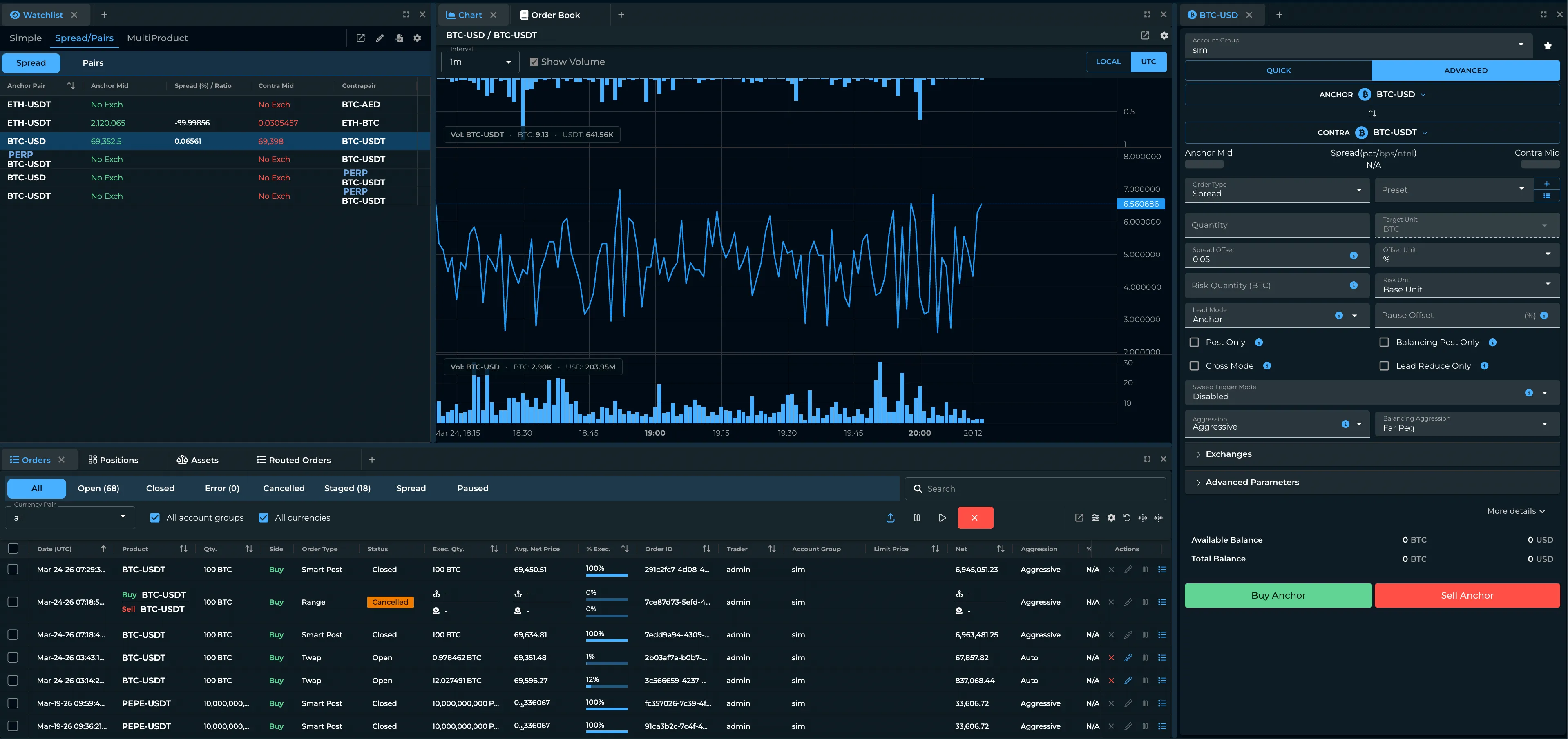
How to Evaluate a Crypto EMS: Build vs Buy and Vendor Selection
CoinRoutes
Choosing a crypto execution management system (EMS) comes down to a handful of criteria — execution quality, liquidity and routing, venue coverage, risk controls, connectivity, support, and commercial flexibility — weighted against the alternative of building it yourself. This is a vendor-neutral framework for running that evaluation, so you can judge any platform (including CoinRoutes) on the same yardstick.
Start with the build-vs-buy question
Connecting to a single exchange API is genuinely straightforward, which leads many sophisticated desks to assume they should build. The honest case for building: you want full control, you have unusual requirements, and you have engineers to spare indefinitely. The honest case against:
The value isn't the connectors — it's the execution layer. Consolidated market data, smart order routing, and high-quality posting/scheduling algorithms are what move the cost needle, and they take years to get right.
Maintenance never stops. Exchanges change APIs, add venues, and alter fee schedules constantly. Every connector you build is a connector you maintain forever.
Time-to-market is a real cost. Months spent building plumbing is alpha not captured.
A useful gut-check: even quant firms that can build sometimes find a specialist platform executes measurably better than their internal system on the same symbols. If you build, benchmark honestly against a specialist before committing.
The seven evaluation criteria
1. Execution quality
The core of an EMS. Look past feature lists to measured outcomes: does the algo suite (passive posting, TWAP/Scheduled Post/TimePace, POV, spread, pairs) post maker-first and price intelligently, or just cross the spread on a timer? Ask for TCA evidence benchmarked against arrival mid and VWAP, and check the maker/taker ratio.
2. Liquidity and routing
Execution is only as good as the liquidity beneath it. Evaluate the consolidated order book and whether routing is fee- and depth-aware — netting fees into the routing decision, not just chasing headline price. This is what turns fragmented venues into one pool.
3. Venue coverage
Map the platform's venues against where you actually trade: tier-1 CEXs, perp DEXs, spot DEXs, OTC liquidity providers, and futures (e.g., CME via a futures gateway). Ask how fast a new venue or token can be added — coverage you'll need in six months matters as much as today's list.
4. Risk controls
Pre-trade risk is non-negotiable for institutions: order-size limits (hard and soft), gross/net exposure tracking, reduce-only, venue/instrument whitelisting, and admin-level configuration so controls don't depend on per-order UI input. (See the dedicated risk-controls article.)
5. Connectivity and integration
REST for testing, WebSocket for production order entry and drop-copy, and FIX for order entry and drop-copy where required. Check for a UAT/sandbox environment, sample code, and a clear story on API versioning and release communication.
6. Support, onboarding, and security
How fast can you go live? Is there a real-time support channel? Are SOC 2 and a third-party penetration test available for due diligence? Does the vendor have a named security contact for DDQs?
7. Commercial terms
Pricing model (basis points on volume vs. flat fee), monthly minimums, volume tiers, multi-tenant vs. dedicated instance, and — importantly — contract flexibility (month-to-month vs. long lock-ins). Trial terms and ramp structures reveal how confident a vendor is in its own product.
A scoring framework
Criterion | What "good" looks like | Weight (example) |
|---|---|---|
Execution quality | TCA-proven, maker-first algos | High |
Liquidity & routing | Fee- and depth-aware consolidated book | High |
Venue coverage | Matches your map + fast additions | Medium |
Risk controls | Admin-level pre-trade controls | High |
Connectivity | REST/WS/FIX + UAT + docs | Medium |
Support & security | SOC 2, pen test, fast onboarding | Medium |
Commercial terms | Flexible contracts, sensible minimums | Medium |
Weight the criteria to your own priorities, score each candidate, and require evidence — a live trial and a TCA report — rather than taking claims at face value.
Where CoinRoutes fits
Measured against this framework, CoinRoutes is built around signal-driven execution quality (its posting and scheduling algos on a consolidated, fee-aware order book), broad CeFi/DeFi/OTC venue coverage with CME access, admin-level pre-trade risk controls, REST/WebSocket/FIX connectivity with a UAT environment, and flexible commercial terms. The point of the framework, though, is that you can hold any platform to the same standard — and should.
This article is a general buyer's framework, not an endorsement or a comparison of specific named competitors. Evaluate vendors against your own requirements and a live trial.
Frequently asked questions
Should we build our own execution stack or buy an EMS? Build if control and unusual requirements outweigh the ongoing cost of maintaining connectors and the time-to-market hit. Buy if you want a proven execution layer now — and either way, benchmark against a specialist before deciding, since connectors are easy but a high-quality execution layer is not.
What's the single most important EMS criterion? Measured execution quality on a fee- and depth-aware consolidated book. Everything else (venues, connectivity, terms) supports it. Insist on TCA evidence, not feature lists.
Why do contract terms matter in EMS selection? Flexible, month-to-month terms reduce switching risk and signal a vendor's confidence in its product; long lock-ins shift that risk onto you. Weigh them alongside pricing model and minimums.
How do I verify a vendor's claims? Run a live trial on your own flow and review a TCA report benchmarked against arrival mid and VWAP, plus the maker/taker ratio. Request SOC 2 and penetration-test documentation for due diligence.
Running an EMS evaluation? Book a demo to benchmark CoinRoutes against your criteria on real flow.
Related reading: What Is a Crypto Execution Management System (EMS)? · EMS vs OEMS vs PMS in Crypto · Does CoinRoutes Have Pre-Trade Risk Controls? · How Institutions Measure Execution Quality · What Is Smart Order Routing?
Request a demo
Find out how CoinRoutes can simplify the way you interact with digital asset markets.