What Are Perpetual Futures and Funding Rates?
CoinRoutes Research Team
Company
What Are Perpetual Futures and Funding Rates?
CoinRoutes Research Team | November 19, 2026
This note explains what a perpetual future is, how the funding rate keeps its price close to spot, and why funding is a real trading cost for institutional desks. It is written for traders who are new to crypto derivatives, or who want a clear refresher.
DEFINITION: A perpetual future is a futures contract with no expiry date. A small payment between buyers and sellers, called funding, keeps its price close to the spot price. |
Perpetual futures, often called "perps" or "perpetual swaps", are the most traded product in crypto. On most large exchanges, daily volume in perps is several times higher than in spot. They let a trader go long or short with leverage, and hold the position for as long as they want. But a contract that never expires needs another way to stay tied to the real price of the asset. That job belongs to the funding rate.
What a perpetual future is
01 - Rule of thumb: a perp gives you futures-style leverage with spot-style holding time. |
A normal futures contract has a fixed end date. On that date it settles, and its price must meet the spot price. Before expiry, the gap between the two, called the basis, slowly shrinks toward zero. A perpetual future removes the end date. The contract simply rolls on, day after day, so there is no natural moment that forces it back to spot.
This makes perps simple to use. A trader does not need to close one contract and open the next one every month or quarter. They post margin, choose their leverage, and hold. Crypto exchanges first offered this design in 2016, and it quickly became the main way people trade bitcoin and other tokens with leverage. Today almost every large venue lists perps, either settled in stablecoins (linear) or in the coin itself (inverse).
Without an expiry, however, the perp price could drift far from spot if one side of the market is much stronger. Funding is the tool that stops this drift.
How the funding rate works
02 - Framework: perp above spot, longs pay shorts. Perp below spot, shorts pay longs. |
Funding is a regular payment made directly between traders who hold long and short positions. The exchange does not keep it. On many venues it is paid every eight hours, while some venues pay every hour. The size and direction of each payment depend on where the perp trades compared with spot.
When the perp trades above spot, the funding rate is positive. Longs pay shorts. This makes it more expensive to stay long and more rewarding to be short, so traders sell the perp and its price moves back down. When the perp trades below spot, the rate turns negative and the flow reverses: shorts pay longs, which pulls the price back up.
Most exchanges build the rate from two parts. The first is a premium, which measures how far the perp is from an index of spot prices. The second is a small fixed interest part. Many venues also cap the rate so that a single payment cannot become extreme. The payment itself is simple:
Funding payment = Position value × Funding rate |
For example, if you hold a long position worth $10 million and the funding rate for the period is 0.01%, you pay $1,000 to the shorts at that funding time. If that rate holds for three periods a day, the cost is $3,000 a day, or close to 11% a year. These figures are illustrative, but they show how quickly small rates add up.
Why funding matters for institutional desks
03 - In practice: funding is a holding cost or a source of income, and it changes from venue to venue. |
For a desk that holds perp positions for days or weeks, funding can cost more than spread, fees and slippage combined. A position that looks profitable on price alone can lose money once funding is counted. This is why good desks track funding as a separate line in their profit and loss, and check it before they open a position, not after.
Funding is also not the same everywhere. Each exchange sets its own rate based on its own traders and its own order book. At the same moment, the rate for the same coin can be high on one venue and much lower on another. A desk that only looks at one exchange may pay far more than it needs to.
Finally, funding creates opportunities. When rates are strongly positive, a trader can buy spot and sell the perp at the same time. The two positions cancel out the price risk, and the trader collects funding from the longs. This is one form of basis trading, and it depends on fast, accurate execution of both legs at once. If one leg fills late or at a poor price, the profit from funding can disappear.
How CoinRoutes fits
IN PRACTICE - CoinRoutes: one view of price, depth and cost across 60+ venues, spot and derivatives. |
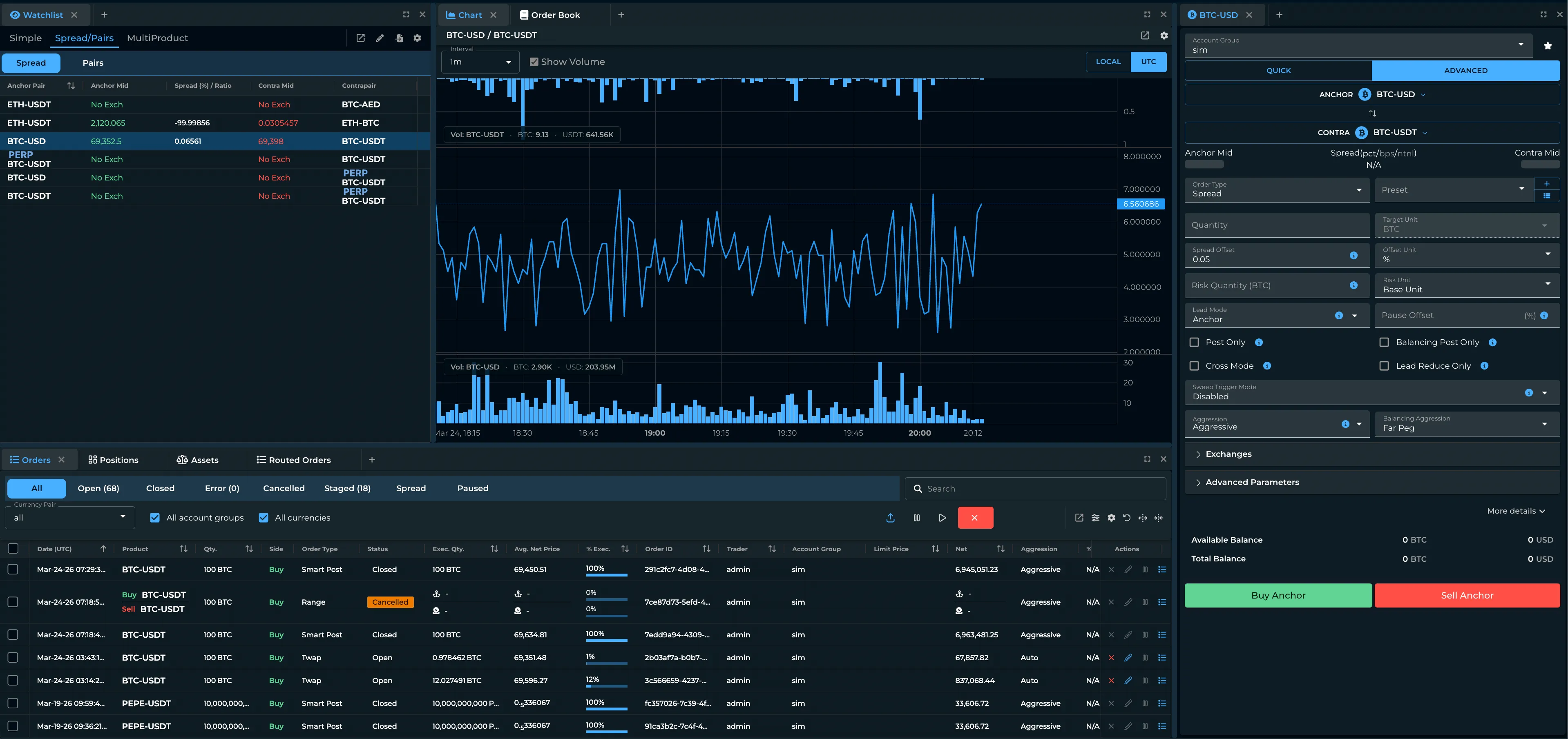
CoinRoutes is an institutional trading platform that connects to more than sixty venues from a single execution management system (EMS). For perpetual futures, this means a desk can compare prices and order book depth across exchanges in one place, instead of switching between screens. Smart order routing then sends each order to the venue with the best price and liquidity at that moment.
For strategies that combine spot and perps, such as cash-and-carry or funding capture, the CoinRoutes algo suite can work both legs together. Built-in trade analytics then measure the real cost of each trade against arrival price and other benchmarks. Together, these tools help desks see the full cost of holding a perp position, and keep that cost under control.
Funding will always be part of trading perpetual futures. The goal is not to avoid it, but to understand it, measure it, and choose the right venue and timing so that it works for you rather than against you.
Exhibits and examples are illustrative and do not quote market data. Funding schedules, formulas and caps differ by exchange; always check each venue's own rules. This note is for informational purposes only and is not investment advice.
Request a demo
Find out how CoinRoutes can simplify the way you interact with digital asset markets.