What Is an Institutional Trading Platform?
CoinRoutes Research Team
Company
What Is an Institutional Trading Platform? A Simple Guide for Crypto Desks
CoinRoutes Research Team | November 24, 2026 | 9 min read
This guide explains what an institutional trading platform is, how it differs from a retail exchange account, and which features matter most for funds, asset managers and trading firms that trade digital assets.
DEFINITION: An institutional trading platform is software that lets professional investors trade large orders across many markets from one place, with the speed, controls and reporting their business needs.
An institutional trading platform is built for firms, not individuals. It connects a trading desk to many exchanges and liquidity providers at once, helps it get the best price on large orders, and keeps a full record of every trade for risk and compliance teams.
In traditional markets, these platforms have been standard for decades. In crypto, they matter even more. Liquidity is spread across dozens of exchanges, OTC desks and onchain markets, prices differ from venue to venue, and markets never close. For an institution, the trading platform is often what separates a good fill from an expensive one.
Institutional vs retail trading: what is the difference?
01 - Rule of thumb: retail tools help one person place an order. Institutional platforms help a team manage size, risk and proof of best execution.
A retail trader usually logs in to one exchange, clicks buy or sell, and the order fills in a second. That works well for small amounts. It does not work for a fund that needs to buy $20 million of bitcoin. An order that size can use up the best prices on a single exchange and push the price against the buyer. Institutions also have duties that retail traders do not: they must protect client money, control risk across a team, and prove to investors and regulators that they traded well.
Feature | Retail exchange account | Institutional trading platform |
|---|---|---|
Market access | One exchange at a time | Many exchanges, OTC desks and DeFi venues on one screen |
Order size | Small orders that fill at once | Large orders that need careful execution |
Order types | Market, limit and stop orders | Execution algorithms such as TWAP, VWAP and POV |
Price view | One order book | A consolidated order book across all venues |
Risk controls | Basic account limits | Pre-trade limits, user permissions and kill switches |
Reporting | A list of past trades | Transaction cost analysis and a full audit trail |
Users | One person | Teams with roles, permissions and approvals |
The core parts of an institutional crypto trading platform
02 - Framework: access, execution, control and measurement.
Every institutional crypto trading platform is different, but the strong ones share the same building blocks. Together they help a desk reach liquidity, trade it well, stay within its limits and measure the result.
Multi-venue access
One connection to many centralized exchanges, OTC liquidity providers and onchain markets. The desk does not need a separate login, API and screen for each venue.
A consolidated order book
All the bids and offers from every connected venue, shown as one book. This gives the true best price in the whole market, not just on one exchange. Read more in What Is a Consolidated Crypto Order Book (CBBO)?.
Smart order routing
Software that splits each order and sends each piece to the venue with the best price and depth at that moment, after fees. See What Is Smart Order Routing (SOR) in Crypto?.
Execution algorithms
Tools that break a large order into small pieces and trade them over time, so the order does not move the market. Common examples are TWAP, VWAP, POV and implementation shortfall. See Crypto Execution Algorithms Explained.
Order and execution management (OMS/EMS)
The workspace where portfolio managers create orders and traders work them. Learn how the two fit together in EMS vs OEMS vs PMS in Crypto.
Pre-trade risk controls
Checks that run before an order is sent, such as maximum order size, price limits and per-user permissions. They stop costly mistakes before they reach the market.
Transaction cost analysis (TCA)
Reports that compare each fill with benchmarks such as arrival price and VWAP, so the desk can prove best execution. See What Is TCA for Digital Assets?.
Portfolio and risk view
A live picture of positions, exposure and profit and loss across every venue, wallet and custodian.
Who uses an institutional trading platform?
03 - In practice: any firm whose order size can move the market, or whose clients expect proof of good execution.
Hedge funds use these platforms to run strategies across many venues and to keep trading costs low. Asset managers use them to build and rebalance portfolios while meeting best execution duties. Proprietary trading firms rely on fast routing and algorithms to capture small price differences. OTC and agency desks use them to fill client orders at the best available price. Prime brokers use them to offer execution as a service to their own clients. Treasuries and family offices that hold large crypto positions use them for the same reason as everyone else: to trade size without paying for it in slippage.
How to choose an institutional crypto trading platform
04 - Checklist: seven questions to ask any vendor before you sign.
Liquidity: how many venues does it connect to, and does it cover CeFi, DeFi and OTC liquidity providers?
Routing: does it route on the full consolidated order book, including fees, or only on the top price?
Algorithms: does it offer algorithms built for crypto market structure, not just copies of equity algos?
Risk: can you set pre-trade limits per user, per account and per asset?
Measurement: does it provide TCA on every order against clear benchmarks such as arrival price?
Custody and keys: do you keep control of your exchange accounts and assets, or must funds move to the vendor?
Integration: does it connect to your portfolio, accounting and reporting systems through APIs and FIX?
For a deeper look at the build-versus-buy decision, read How to Evaluate a Crypto EMS.
How CoinRoutes fits
IN PRACTICE - CoinRoutes: execution, routing, risk and portfolio monitoring for digital assets in one platform.
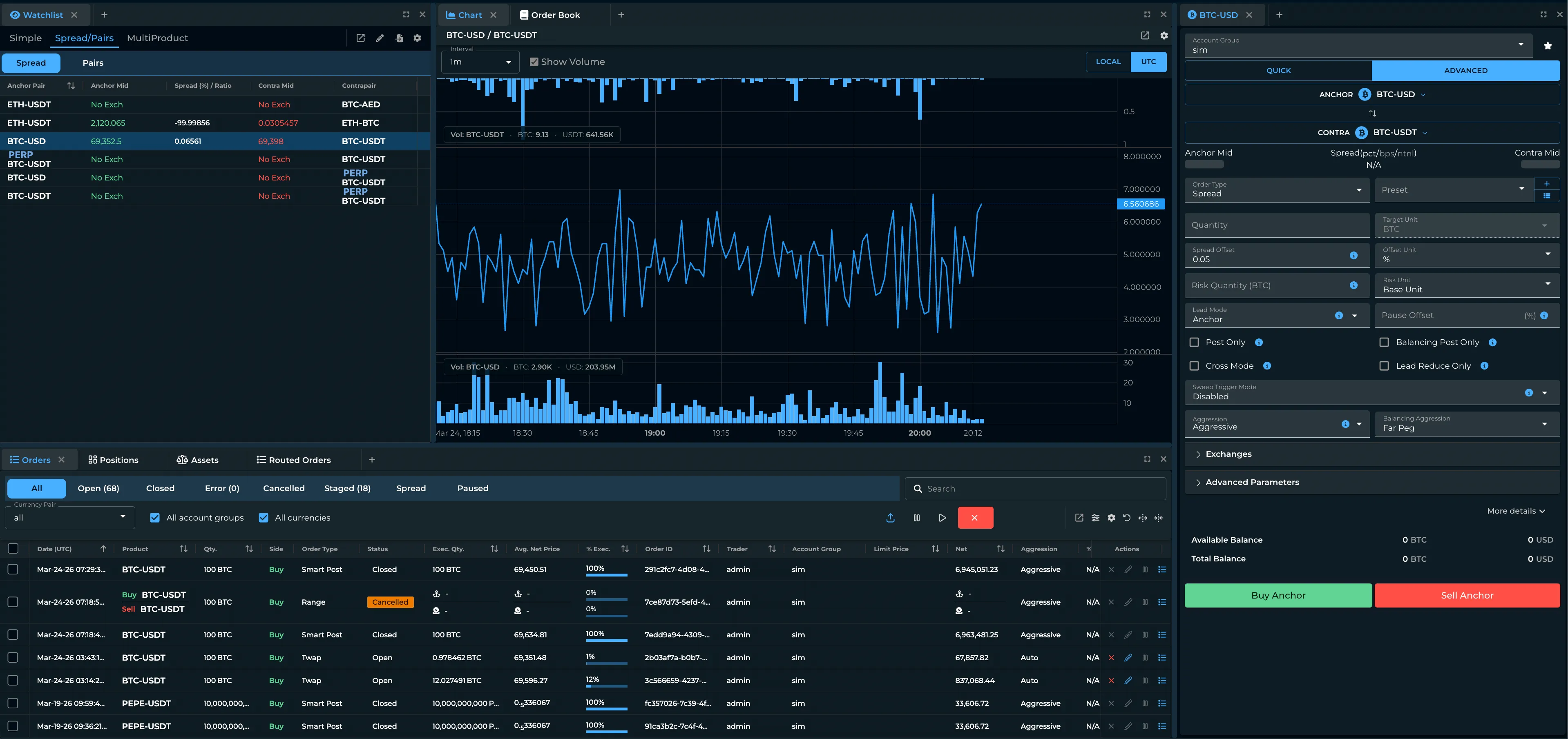
CoinRoutes is an institutional trading platform built for digital assets. From a single execution management system (EMS), desks can trade across more than sixty centralized exchanges, DeFi venues and liquidity providers in one order. Its patented smart order routing reads a consolidated order book in real time and sends each slice to where the best price and depth really are.
A full suite of crypto-native algorithms, including Smart Post, TWAP, POV, Time Pace, Scheduled Post, Smart Stop, Spread and Multi Product, lets traders choose how fast and how aggressively to work each order. Pre-trade risk controls set limits before orders reach the market, and built-in transaction cost analysis measures every order against benchmarks such as arrival price.
For portfolio and risk, CoinRoutes Clarity brings together positions across exchanges, wallets and custodians, with live profit and loss, exposure monitoring and more than 75 counterparty integrations. In 2026, CoinRoutes was named Algorithmic Trading Solution Provider of the Year and Risk Management Software of the Year at the Hedgeweek Global Digital Assets Awards.
An institutional trading platform does not make markets easier. It makes them manageable. The right one gives a desk access to all the liquidity it needs, the tools to trade it well, and the data to prove it.
Frequently asked questions
What is an institutional trading platform?
It is professional trading software that lets funds, asset managers and trading firms trade large orders across many markets from one place, with risk controls and detailed reporting.
What is the difference between an institutional and a retail trading platform?
A retail platform gives one person access to one market with simple order types. An institutional platform connects to many venues, uses smart order routing and execution algorithms, enforces risk limits for whole teams, and reports on trading costs.
What is an institutional crypto trading platform?
It is an institutional trading platform built for digital assets. It connects to crypto exchanges, OTC desks and DeFi venues, and is designed for markets that are fragmented, volatile and open 24 hours a day.
What is the difference between an OMS and an EMS?
An order management system (OMS) is where orders are created, approved and tracked. An execution management system (EMS) is where traders work those orders in the market. Many institutional platforms combine both.
Do institutions buy crypto directly on exchanges?
Many do, but usually through a platform that connects to several exchanges at once, plus OTC and RFQ liquidity. This helps them find more liquidity and reduce market impact.
Do I need to move my funds to use an institutional trading platform?
Not always. Some platforms, including CoinRoutes, connect to the exchange accounts you already hold, so your assets stay in your own accounts. Always check how each vendor handles custody and keys.
Exhibits and examples are illustrative. Product features described are as of the publication date. This note is for informational purposes only and is not investment advice.
Request a demo
Find out how CoinRoutes can simplify the way you interact with digital asset markets.